Industrial Automation Guide: Technologies, Benefits, Applications and Best 5 Platforms Comparison

Introduction To Industrial Automation
Walk into any modern manufacturing plant today, and you’ll notice something that would’ve seemed like science fiction twenty years ago: robotic arms welding car frames with millimeter precision, sensors predicting equipment failure days before it happens, and production lines that adjust themselves in real time. I’ve spent years working alongside manufacturing teams implementing these systems, and industrial automation has genuinely transformed from a competitive advantage into an operational necessity.
Quick answer: Industrial automation refers to the use of control systems, robotics, software, and sensor technology to perform manufacturing and production tasks with minimal human intervention. It includes fixed automation, programmable automation, and flexible automation, and it delivers measurable benefits like increased productivity, reduced errors, lower labor costs, and improved workplace safety.
In this guide, you’ll find:
- A clear explanation of what industrial automation actually involves
- The main types and technologies driving automation today
- Real, measurable benefits backed by industry data
- Practical applications across different industries
- A comparison of leading automation platforms and tools
- Implementation best practices from real deployment experience
- Common challenges companies face, and how to avoid them
- A practical checklist and FAQ section to settle remaining questions
By the end, you’ll have a complete, grounded understanding of industrial automation without needing to piece together information from a dozen different sources.
What Is Industrial Automation?
Industrial automation is the application of control systems — including computers, robots, and information technologies — to handle different processes and machinery in an industry, replacing or assisting human operators. The goal isn’t necessarily to eliminate workers entirely, but to handle repetitive, dangerous, or precision-critical tasks more consistently than manual labor allows.
Automation in industrial settings spans a huge range, from a simple thermostat controlling temperature in a chemical reactor, to a fully automated assembly line producing thousands of identical components per hour with barely any human oversight.
According to the International Federation of Robotics, global installations of industrial robots have continued climbing year over year, with manufacturing sectors like automotive and electronics leading adoption rates worldwide.
I’ve walked factory floors both before and after automation upgrades, and the difference isn’t subtle. One plant I consulted for reduced a critical assembly step from four minutes of manual labor to 45 seconds of automated precision work — and virtually eliminated the defect rate tied to that step in the process.
Why Industrial Automation Matters Now More Than Ever
Labor shortages, rising production costs, and increasing quality expectations have pushed industrial automation from “nice to have” to essential infrastructure for staying competitive.
Consider these driving factors:
- Labor shortages in manufacturing continue to challenge companies trying to fill skilled positions
- Rising wage costs make automation increasingly cost-competitive over time
- Quality consistency demands from customers and regulators keep tightening
- Supply chain pressures require faster, more flexible production capabilities
- Workplace safety regulations push companies to automate hazardous tasks
💡 Tip: Companies that approach automation purely as a cost-cutting measure often see disappointing results. The most successful implementations I’ve seen treat it as a quality and consistency improvement strategy first, with cost savings as a secondary benefit.
Types of Industrial Automation
Understanding the different categories of industrial automation helps clarify which approach fits specific production needs. There are generally four recognized types.
1. Fixed Automation
Also called hard automation, this involves machinery designed to perform a specific, unchanging sequence of operations. Think of a bottling line that fills, caps, and labels bottles in exactly the same sequence, every time.
Best for: High-volume production of identical products where the process rarely changes.
2. Programmable Automation
This type allows equipment to be reprogrammed for different product variations or batch runs. CNC machines are a classic example — the same machine can produce different parts simply by loading a new program.
Best for: Batch production environments where product specifications change periodically.
3. Flexible Automation
Building on programmable automation, flexible systems can switch between different products with minimal downtime, often without manual reconfiguration. Robotic arms with interchangeable end-effectors are a common example.
Best for: Manufacturers producing multiple product variants on the same production line.
4. Integrated Automation
This represents the most advanced level, where entire production processes — from raw material handling to final packaging — are coordinated through a centralized control system, often incorporating real-time data exchange between machines.
Best for: Large-scale operations aiming for full production visibility and minimal human intervention.
| Automation Type | Flexibility | Setup Cost | Best For |
|---|---|---|---|
| Fixed | Low | Lower | High-volume, unchanging products |
| Programmable | Medium | Moderate | Batch production |
| Flexible | High | Higher | Multiple product variants |
| Integrated | Very High | Highest | Full-scale smart factories |
Core Industrial Automation Technologies
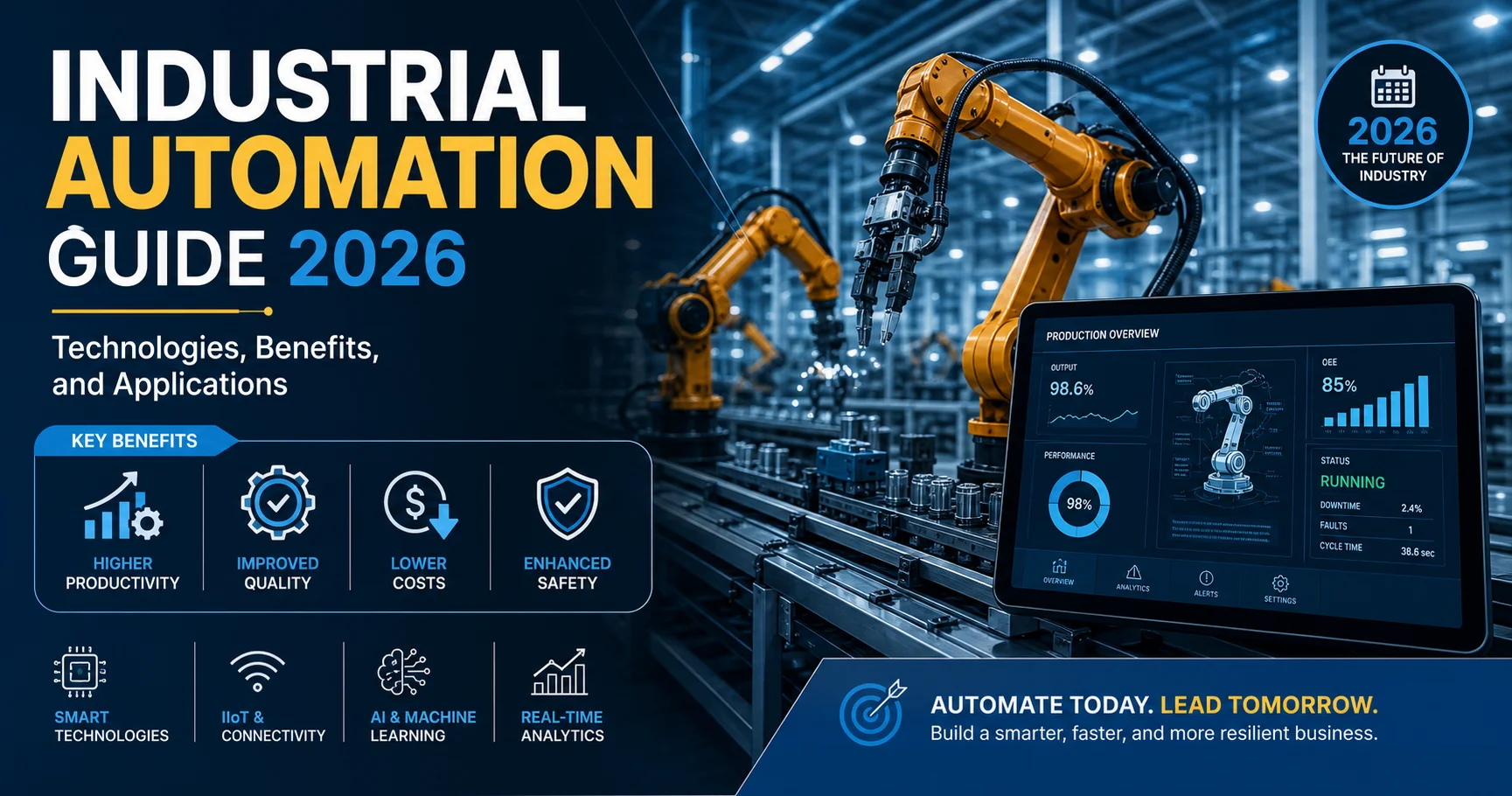
Industrial automation isn’t a single technology — it’s an ecosystem of interconnected systems working together. Here’s a breakdown of the core technologies driving it in 2026.
1. Programmable Logic Controllers (PLCs)
PLCs are the workhorses of industrial automation, serving as the digital brain controlling machinery operations based on programmed logic. They’re rugged, reliable, and have been the backbone of factory automation for decades.
2. Industrial Robots
Robotic arms handle tasks like welding, painting, assembly, and material handling with precision that’s extremely difficult to match manually. Modern collaborative robots, known as “cobots,” are designed to work safely alongside human employees rather than replacing them entirely.
3. SCADA Systems
Supervisory Control and Data Acquisition (SCADA) systems allow operators to monitor and control industrial processes across large facilities from a centralized interface, often displaying real-time data from hundreds of sensors simultaneously.
4. Industrial Internet of Things (IIoT)
IIoT connects machines, sensors, and devices to collect and share data in real time. This connectivity enables predictive maintenance, where equipment issues are flagged before they cause costly downtime.
“Predictive maintenance enabled by IIoT sensors can reduce unplanned equipment downtime significantly,” according to research published by McKinsey & Company, which has studied manufacturing digitization trends extensively.
5. Artificial Intelligence and Machine Learning
AI algorithms analyze production data to identify patterns humans might miss — detecting subtle quality defects, optimizing energy consumption, or predicting maintenance needs based on historical failure data.
6. Human-Machine Interfaces (HMIs)
HMIs provide the visual interface operators use to monitor and control automated systems, translating complex machine data into readable dashboards and control panels.
7. Digital Twins
A digital twin is a virtual replica of a physical production system, allowing engineers to simulate changes, test scenarios, and identify potential issues before implementing them on the actual factory floor.
⚠️ Important: Implementing IIoT and AI-driven systems without proper cybersecurity measures creates significant vulnerability. Industrial control systems have increasingly become targets for cyberattacks as connectivity expands.
Benefits of Industrial Automation: What the Data Shows
Having worked through multiple automation implementations, I can confirm the benefits are real — but they’re not always immediate or uniform across industries. Here’s what consistently shows up.
1. Increased Productivity
Automated systems can operate continuously without fatigue, breaks, or shift changes. A properly calibrated automated line consistently outpaces manual production rates, especially for repetitive tasks.
2. Improved Product Quality and Consistency
Machines don’t get tired or distracted. Automated quality control systems, including vision inspection technology, catch defects far more consistently than manual visual inspection.
3. Enhanced Workplace Safety
Automation handles dangerous tasks — heavy lifting, exposure to hazardous materials, repetitive strain-inducing movements — reducing workplace injury rates significantly in facilities that have automated high-risk processes.
4. Reduced Operating Costs Over Time
While initial investment is substantial, automated systems reduce long-term labor costs, minimize material waste through precision, and lower costs associated with quality defects and rework.
5. Better Data Visibility
Automated systems generate continuous data streams, giving plant managers real-time visibility into production metrics that would be impossible to track manually at the same granularity.
6. Scalability
Once an automated process is established, scaling production often requires less proportional increase in labor compared to purely manual operations.
According to the International Federation of Robotics’ World Robotics Report, the automotive and electronics industries continue to represent the largest share of industrial robot installations globally, reflecting sustained confidence in automation’s return on investment.
Real-World Applications of Industrial Automation
Industrial automation isn’t confined to car factories anymore. Here’s how different industries are actually applying it.
Automotive Manufacturing
This remains the largest adopter of industrial robotics, using automated systems for welding, painting, assembly, and quality inspection. Precision and consistency requirements in automotive production make it a natural fit for heavy automation investment.
Food and Beverage Production
Automated systems handle packaging, sorting, and quality control, where hygiene standards and speed requirements make manual processing increasingly impractical at scale.
Pharmaceutical Manufacturing
Strict regulatory requirements around consistency and contamination control make automation essential in pharmaceutical production, particularly for precise dosing and packaging processes.
Electronics Manufacturing
Surface-mount technology (SMT) lines use highly precise automated placement machines to assemble circuit boards with components too small for reliable manual handling.
Warehousing and Logistics
Automated guided vehicles (AGVs) and robotic picking systems have transformed warehouse operations, particularly within e-commerce fulfillment centers managing massive order volumes.
Oil, Gas, and Chemical Processing
SCADA systems and automated control loops manage complex, often hazardous processes continuously, reducing the need for human presence in dangerous environments.
💡 Practical Insight: Industries with high repetition, strict quality requirements, or hazardous conditions typically see the fastest return on automation investment. If your production involves none of these factors, the ROI timeline may be considerably longer.
Leading Industrial Automation Platforms: A Comparison
Choosing the right automation platform depends heavily on your industry, scale, and existing infrastructure. Based on direct exposure to implementations and industry feedback, here’s how major players compare.
| Platform | Rating | Best For | Ease of Integration | Notable Strength |
|---|---|---|---|---|
| Siemens SIMATIC | ⭐⭐⭐⭐½ (4.6/5) | Large-scale manufacturing | Moderate | Comprehensive PLC ecosystem |
| Rockwell Automation | ⭐⭐⭐⭐½ (4.5/5) | North American manufacturing | Moderate | Strong SCADA integration |
| ABB Robotics | ⭐⭐⭐⭐ (4.4/5) | Robotics-heavy production | Moderate-Hard | Advanced robotic precision |
| Schneider Electric | ⭐⭐⭐⭐ (4.3/5) | Energy-conscious facilities | Easy-Moderate | Strong sustainability tools |
| Honeywell Process Solutions | ⭐⭐⭐⭐ (4.2/5) | Oil, gas & chemical processing | Moderate | Robust process control |
Ratings reflect aggregated industry feedback and professional assessments as of early 2026.
A quick note from practical experience: Siemens tends to dominate in facilities already standardized on their ecosystem since switching control systems entirely is costly and disruptive. Rockwell Automation remains particularly strong in North American facilities due to established support networks and technician familiarity.
How to Implement Industrial Automation: Step-by-Step
If you’re considering automating part of your operation, here’s a realistic roadmap based on actual implementation experience.
- Conduct a process audit to identify which tasks are repetitive, hazardous, or quality-critical
- Calculate potential ROI by comparing current labor and error costs against estimated automation investment
- Start with a pilot project on a single production line rather than a full-facility overhaul
- Choose the right automation type (fixed, programmable, flexible, or integrated) based on product variability
- Select compatible technology partners who can integrate with your existing infrastructure
- Train staff thoroughly before full deployment, including both operators and maintenance teams
- Implement cybersecurity protocols alongside any connected or IIoT-enabled systems
- Monitor performance data closely during the first few months to catch calibration issues early
- Scale gradually to additional lines or processes based on pilot results
- Establish a predictive maintenance schedule to maximize equipment lifespan and minimize downtime
⚠️ Common Mistake: Many companies attempt full-facility automation rollouts without piloting first. This dramatically increases risk and often leads to costly reconfiguration once real-world issues surface that weren’t apparent during planning.
Industrial Automation Best Practices
Beyond the implementation roadmap, here are practices that consistently separate successful automation projects from costly failures.
1. Involve Floor Operators Early
The people currently doing the manual work often understand process nuances better than anyone else. Involving them in automation planning surfaces practical issues that pure engineering analysis might miss.
2. Don’t Automate a Broken Process
Automating an inefficient process just makes it fail faster and more expensively. Fix and optimize the workflow manually first, then automate the improved version.
3. Plan for Maintenance From Day One
Automated systems require regular maintenance and occasional recalibration. Budget for ongoing technical support, not just the initial equipment purchase.
4. Prioritize Modular, Scalable Systems
Choosing equipment that can be reconfigured or expanded later prevents costly full replacements as production needs evolve.
5. Build in Redundancy for Critical Processes
A single point of failure in a fully automated line can halt entire production. Identify critical bottlenecks and build in backup systems or manual override capabilities.
6. Invest in Workforce Reskilling
Automation shifts labor needs rather than eliminating them entirely. Operators often transition into technical roles overseeing and maintaining automated systems, which requires new skill development.
“The workforce of the future in manufacturing will need digital literacy alongside traditional technical skills,” notes analysis from the World Economic Forum’s Future of Jobs Report, which has tracked automation’s impact on employment trends across industries.
Common Challenges in Industrial Automation (And How to Solve Them)
Challenge 1: High Initial Investment Costs
Automation equipment, integration, and training represent substantial upfront costs. Solution: Start with a focused pilot project targeting your highest-impact bottleneck rather than attempting comprehensive automation immediately.
Challenge 2: Integration With Legacy Systems
Older facilities often run equipment that wasn’t designed with modern connectivity in mind. Solution: Work with integration specialists experienced in retrofitting legacy systems rather than assuming full replacement is the only option.
Challenge 3: Workforce Resistance
Employees understandably worry automation threatens their jobs. Solution: Communicate transparently about reskilling opportunities and involve staff in the transition process from the beginning.
Challenge 4: Cybersecurity Vulnerabilities
Connected industrial systems create new attack surfaces for cybercriminals. Solution: Implement network segmentation, regular security audits, and employee training on industrial cybersecurity protocols.
Challenge 5: Downtime During Implementation
Installing new automated systems inevitably disrupts production temporarily. Solution: Schedule implementation during planned maintenance windows or lower-demand periods to minimize business impact.
Industrial Automation vs. Manual Processes: Quick Comparison
| Factor | Manual Processes | Industrial Automation |
|---|---|---|
| Speed | Limited by human capacity | Consistently faster for repetitive tasks |
| Consistency | Variable | Highly consistent |
| Initial Cost | Lower | Higher upfront investment |
| Long-term Cost | Higher labor costs over time | Lower operational costs over time |
| Safety | Higher injury risk for hazardous tasks | Reduced human exposure to danger |
| Flexibility | Easily adjusted by workers | Requires reprogramming or reconfiguration |
| Scalability | Limited by workforce availability | Easier to scale production volume |
Practical Checklist Before Implementing Industrial Automation
- Identify repetitive, hazardous, or quality-critical processes suitable for automation
- Calculate realistic ROI timelines based on labor and error reduction
- Choose the appropriate automation type for your production variability
- Select technology partners compatible with existing infrastructure
- Plan a pilot project before full-scale rollout
- Budget for ongoing maintenance and technical support
- Develop a cybersecurity protocol for connected systems
- Create a workforce reskilling and communication plan
- Establish performance monitoring metrics from day one
- Schedule implementation during low-impact production periods
Frequently Asked Questions About Industrial Automation
What is industrial automation?
Industrial automation is the use of control systems, robotics, and software technologies to perform manufacturing and production tasks with minimal human intervention, improving consistency, speed, and safety across industrial processes.
What are the main types of industrial automation?
The four main types are fixed automation (unchanging processes), programmable automation (reconfigurable for batches), flexible automation (quick product switching), and integrated automation (fully coordinated, facility-wide systems).
How much does industrial automation cost?
Costs vary enormously based on scale and complexity, ranging from a few thousand dollars for simple programmable controllers to several million dollars for full facility-wide integrated automation systems. Most companies see meaningful ROI within 2-5 years, depending on the application.
Will industrial automation eliminate manufacturing jobs?
Automation typically shifts labor needs rather than eliminating them entirely. While some repetitive manual roles decrease, demand increases for technical roles overseeing, maintaining, and programming automated systems.
What industries benefit most from industrial automation?
Automotive, electronics, pharmaceuticals, food and beverage, and oil and gas processing see the most significant benefits, largely due to high repetition, strict quality requirements, or hazardous working conditions.
What’s the difference between automation and robotics?
Robotics refers specifically to programmable machines capable of physical tasks, while industrial automation is the broader concept encompassing robotics, control systems, sensors, and software working together to manage production processes.
How long does it take to implement industrial automation?
Implementation timelines vary from a few weeks for simple programmable systems to over a year for complex, facility-wide integrated automation projects involving significant infrastructure changes.
Final Thoughts
Industrial automation has moved well beyond being an optional upgrade — it’s become foundational infrastructure for manufacturers aiming to stay competitive in 2026 and beyond. From fixed automation handling simple repetitive tasks to fully integrated smart factories coordinating entire production ecosystems, the technology continues evolving at a pace that rewards companies willing to invest thoughtfully and strategically.
The organizations that succeed with automation aren’t necessarily the ones with the biggest budgets. They’re the ones that start with clear process audits, pilot projects before full rollouts, and genuine investment in workforce reskilling alongside the technology itself. Automation without proper planning often creates expensive problems rather than solving existing ones.
Whether you’re running a small manufacturing operation considering your first programmable controller, or managing a large facility evaluating a fully integrated smart factory system, the fundamentals remain consistent: understand your actual process needs first, choose technology that matches your scale and flexibility requirements, and never underestimate the importance of the people who’ll be working alongside these systems every single day.