Generative AI in Cybersecurity: Revolution, Risks, and Practical Guide


Generative AI in Cybersecurity: The Ultimate 2026 Guide to Revolution, Risks, and Defense
We are standing at the edge of the most significant technological shift in the history of digital defense. When we talk about Generative AI in Cybersecurity, we are no longer discussing a futuristic concept reserved for sci-fi novels or Silicon Valley think tanks. We are talking about the present reality of how organizations protect their most sensitive data. The integration of Generative AI in Cybersecurity has fundamentally altered the balance of power between attackers and defenders.
For Chief Information Security Officers (CISOs) and IT leaders, understanding Generative AI in Cybersecurity is no longer optional; it is a critical survival skill. The impact of Generative AI in Cybersecurity is being felt across every layer of the tech stack, from automated code generation to real-time threat hunting. But with this immense power comes an equally immense set of vulnerabilities. The same technology used to shield your network can be weaponized to breach it.
In this comprehensive, no-nonsense guide, we are going to dissect the entire landscape of Generative AI in Cybersecurity. We will explore how it is revolutionizing defense mechanisms, expose the dark side of Generative AI in Cybersecurity risks, and provide you with a highly actionable, practical guide to implementing these tools safely. If you want to stay ahead of the curve in 2026 and beyond, mastering Generative AI in Cybersecurity is where you need to start. Let’s dive deep into the data, the risks, and the strategies that will define the next decade of digital security.
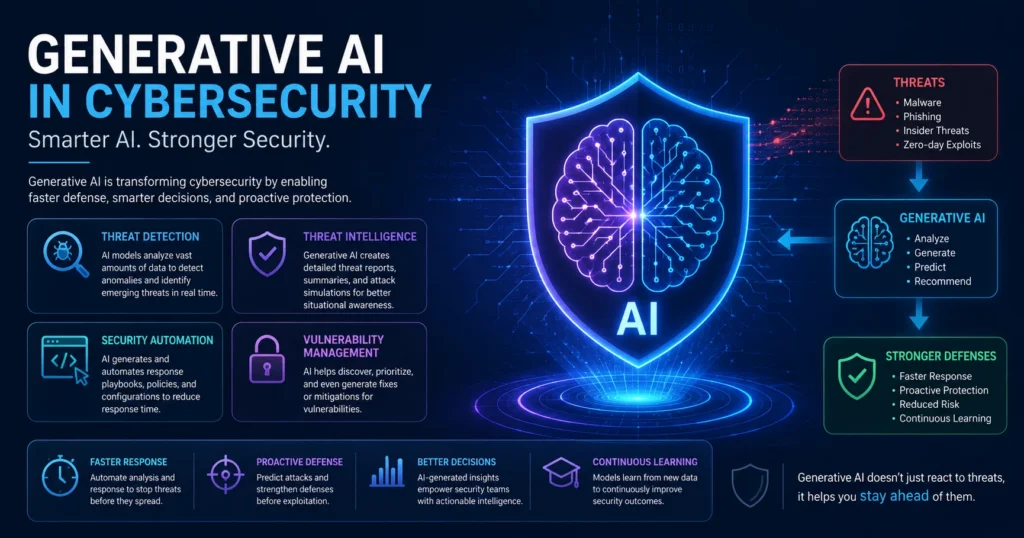
Understanding the Core Mechanics of Generative AI in Cybersecurity
Before we can effectively deploy or defend against these systems, we need to understand what Generative AI in Cybersecurity actually means at a technical level. Unlike traditional machine learning models that are primarily predictive or classificatory (e.g., “Is this file malicious: Yes or No?”), generative models create new, original data based on the patterns they have learned from massive datasets.
When applied to Generative AI in Cybersecurity, this means the AI can generate synthetic data to train other models, write remediation code for vulnerabilities, or even simulate complex attack vectors to test your defenses. The core of Generative AI in Cybersecurity relies heavily on Large Language Models (LLMs) and transformer architectures. These models ingest billions of lines of code, threat intelligence reports, and network logs to understand the “language” of both software and cyberattacks.
The true brilliance of Generative AI lies in its ability to process unstructured data. Traditional security tools struggle with messy, unstructured logs or natural language threat reports. Generative AI in Cybersecurity thrives in this environment. It can read a hacker’s forum post, understand the context of a newly discovered zero-day exploit, and automatically generate a custom detection rule for your Security Information and Event Management (SIEM) system in seconds. This contextual understanding is what makes Generative AI in Cybersecurity such a massive leap forward from legacy, rule-based systems.
However, to truly leverage Generative AI, organizations must feed it high-quality, proprietary data. A generic, out-of-the-box model is only as good as its training. The most successful implementations of Generative AI in Cybersecurity involve fine-tuning base models on an organization’s specific network topology, historical incident data, and unique business logic. This creates a bespoke security brain that knows your environment better than any human analyst ever could.
How Generative AI in Cybersecurity is Revolutionizing Defense
The defensive capabilities unlocked by Generative AI are nothing short of revolutionary. We are moving from a reactive security posture to a highly proactive, predictive one. Let’s break down the specific areas where Generative AI in Cybersecurity is changing the game for security teams.
Automated Threat Detection and Response
The most immediate benefit of Generative AI in Cybersecurity is the drastic reduction in alert fatigue. Security Operations Centers (SOCs) are drowning in thousands of alerts daily. Generative AI in Cybersecurity tools can ingest these alerts, correlate them across multiple data sources, and generate a plain-English summary of the incident.
Instead of an analyst spending 45 minutes investigating a suspicious login, Generative AI can instantly pull the user’s historical behavior, check the IP reputation, analyze the endpoint telemetry, and generate a comprehensive incident report. Furthermore, Generative AI in Cybersecurity can automatically draft and execute remediation scripts. If it detects ransomware encrypting files, it can instantly generate and deploy an isolation script to sever the infected endpoint from the network, all in milliseconds.
Predictive Analytics and Vulnerability Management
Traditional vulnerability scanners just give you a list of CVEs (Common Vulnerabilities and Exposures) and tell you to patch them. Generative AI in Cybersecurity takes this a step further by providing context. It can analyze your specific environment and tell you, “This vulnerability is critical because it sits on a server that processes PII, and there is active exploit code available on the dark web.”
Moreover, Generative AI is revolutionizing patch management by automatically generating the code required to fix vulnerabilities. If a developer pushes code with a SQL injection flaw, Generative AI in Cybersecurity integrated into the CI/CD pipeline can not only flag the error but also write the secure, corrected code and submit a pull request for the developer to review. This shifts security left in the most literal sense possible.
Threat Hunting and Intelligence Synthesis
Threat hunting used to be a highly manual, intuition-driven process. Today, Generative AI in Cybersecurity acts as a force multiplier for threat hunters. You can literally ask your security platform natural language questions like, “Show me any lateral movement attempts involving service accounts in the last 48 hours.” Generative AI in Cybersecurity translates that query into complex database searches and returns the exact data you need.
Additionally, Generative AI in Cybersecurity excels at synthesizing threat intelligence. It can read hundreds of pages of reports from various security vendors, government agencies, and dark web forums, and distill them into a single, actionable executive brief. This allows security leaders to make informed decisions without spending hours reading technical jargon. The ability of Generative AI in Cybersecurity to connect the dots between disparate pieces of intelligence is unparalleled.
The Dark Side: Emerging Risks of Generative AI & Cybersecurity
While the defensive applications are incredible, we must be brutally honest about the risks of Generative AI & Cybersecurity. The exact same models that help defenders catch bad actors are being used by cybercriminals to launch more sophisticated, evasive, and devastating attacks. The risks of Generative AI in Cybersecurity are reshaping the threat landscape in terrifying ways.
Hyper-Personalized Phishing and Social Engineering
The days of poorly spelled, obvious phishing emails are over. Attackers are now using the underlying technology of Generative AI in Cybersecurity to craft hyper-personalized spear-phishing campaigns. By scraping a target’s LinkedIn, social media, and public company communications, attackers can feed this data into an LLM to generate an email that perfectly mimics the tone, style, and context of a colleague or executive.
This is one of the most dangerous risks of Generative AI & Cybersecurity because it bypasses traditional human skepticism. An employee is much more likely to click a link or approve a wire transfer if the email sounds exactly like their boss and references a real, ongoing project. Furthermore, these AI-generated phishing emails are grammatically perfect and lack the typical indicators of compromise that legacy email filters look for. Defending against this specific risk of Generative AI requires advanced behavioral analysis, not just keyword filtering.
Deepfakes and Biometric Spoofing
Another massive risk in the realm of Generative AI in Cybersecurity is the proliferation of deepfakes. Attackers are using generative audio and video models to clone the voices of CEOs or create deepfake video calls to authorize fraudulent transactions. We have already seen real-world cases where employees transferred millions of dollars because they were on a video call with who they thought was their CFO, but was actually an AI-generated avatar.
In the context of Generative AI in Cybersecurity, biometric spoofing is becoming incredibly cheap and accessible. Voice cloning requires only a few seconds of audio, which can be easily harvested from public podcasts or voicemail greetings. This forces organizations to rethink their identity verification processes. Relying solely on voice or facial recognition is no longer sufficient when the risks of Generative AI include flawless biometric forgery. Multi-factor authentication (MFA) and strict verification protocols are now mandatory.
AI-Generated Polymorphic Malware
Perhaps the most technical risk of Generative AI in Cybersecurity is the creation of polymorphic malware. Traditionally, malware had a specific signature that antivirus software could detect. Now, attackers are using generative models to continuously rewrite the code of their malware every time it executes or moves to a new system.
This means the malware’s signature changes constantly, rendering traditional signature-based detection useless. The code remains functionally identical (it still encrypts files or steals data), but the underlying binary looks completely different to security scanners. Combating this specific risk of Generative AI in Cybersecurity requires defenders to move away from signature detection and rely entirely on behavioral analysis and heuristic monitoring. It is an arms race, and currently, the attackers have a slight edge in code generation speed.
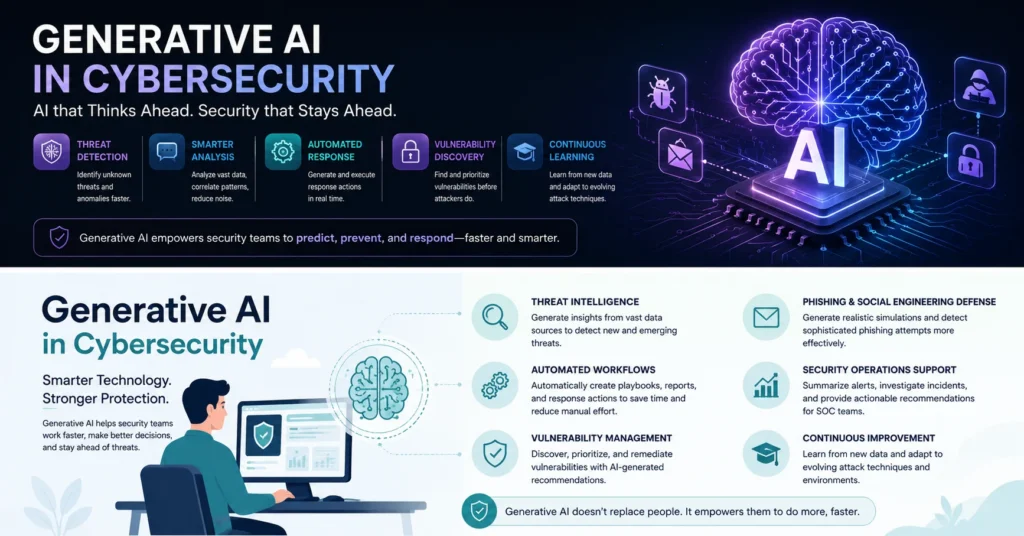
A Practical Guide to Implementing Generative AI in Cybersecurity
Understanding the theory is one thing; executing a strategy is another. If you are a security leader looking to harness the power of Generative AI & Cybersecurity while mitigating the risks, you need a structured approach. Implementing Generative AI in Cybersecurity is not as simple as buying a software license and plugging it in. It requires a fundamental shift in your security architecture.
Here is a practical, step-by-step guide to deploying Generative AI in Cybersecurity in your organization safely and effectively.
Phase 1: Data Preparation and Governance
The foundation of any successful Generative AI in Cybersecurity deployment is clean, structured data. AI models are notoriously susceptible to “garbage in, garbage out.” Before you deploy any Generative AI & Cybersecurity tool, you must ensure your logging, telemetry, and threat intelligence feeds are standardized and normalized.
Furthermore, data governance is critical. You must establish strict policies regarding what data can be fed into public LLMs. A major risk of Generative AI in Cybersecurity is data leakage—accidentally feeding proprietary source code or sensitive customer PII into a public model that uses it for further training. Always opt for enterprise-grade Generative AI in Cybersecurity solutions that guarantee data privacy, zero data retention, and the ability to deploy models on-premises or within your own private cloud VPC.
Phase 2: Start with High-Impact, Low-Risk Use Cases
Do not try to automate your entire SOC on day one. When implementing Generative AI in Cybersecurity, start with use cases that augment human analysts rather than replace them. A great starting point is using Generative AI in Cybersecurity for alert triage and summarization. Let the AI read the alerts and draft the investigation notes, but require a human analyst to make the final call on remediation.
Another excellent early use case for Generative AI in Cybersecurity is security awareness training. Use generative tools to create highly realistic, customized phishing simulations for your employees. This not only tests your human firewall but also gets the organization comfortable with AI-generated content in a controlled environment.
Phase 3: Continuous Monitoring and Model Tuning
Generative AI in Cybersecurity is not a “set it and forget it” technology. AI models can suffer from “drift,” where their accuracy degrades over time as the threat landscape changes. You must continuously monitor the performance of your Generative AI in Cybersecurity tools. Track metrics like false positive rates, mean time to detect (MTTD), and mean time to respond (MTTR).
Additionally, you need to implement a feedback loop. When a human analyst corrects an AI-generated investigation or flags a false positive, that correction must be fed back into the model. This continuous fine-tuning is what separates a mediocre Generative AI in Cybersecurity deployment from a world-class one.
The Generative AI in Cybersecurity Implementation Checklist
To ensure you don’t miss any critical steps, use this practical checklist when rolling out Generative AI in Cybersecurity:
- [ ] Audit Current Data: Ensure all security logs and telemetry are normalized and accessible.
- [ ] Establish Data Governance: Create strict policies prohibiting the use of sensitive data in public AI models.
- [ ] Select the Right Vendor: Choose enterprise Generative AI in Cybersecurity tools that offer private cloud or on-prem deployment options.
- [ ] Define Use Cases: Start with alert triage, report summarization, and code review.
- [ ] Train the Team: Upskill your SOC analysts to work with AI, focusing on prompt engineering and AI output validation.
- [ ] Implement Human-in-the-Loop: Ensure critical actions (like isolating a server or blocking an IP) require human approval initially.
- [ ] Set Up Feedback Loops: Create a mechanism for analysts to flag AI errors and feed corrections back into the model.
- [ ] Monitor for Drift: Schedule monthly reviews of AI accuracy and false positive rates.
Top Tools for Generative AI in Cybersecurity: Market Reviews
The market for Generative AI in Cybersecurity is exploding, with both legacy vendors and agile startups releasing new capabilities. To help you navigate this crowded space, we have compiled a comparative table of the top Generative AI in Cybersecurity platforms, complete with user reviews and ratings.
| Tool / Platform | Core GenAI Feature | Best For | User Review (Stars) | Pros & Cons |
|---|---|---|---|---|
| Microsoft Security Copilot | Natural language incident investigation & KQL generation | Enterprises deeply integrated into the Microsoft ecosystem | ⭐⭐⭐⭐⭐ (4.6 / 5) | Pros: Seamless integration with Sentinel/Defender, excellent natural language processing. Cons: Expensive, requires heavy Microsoft ecosystem reliance. |
| CrowdStrike Charlotte AI | Autonomous threat hunting and AI-driven SOC analyst | Mid-to-large enterprises needing rapid incident response | ⭐⭐⭐⭐⭐ (4.7 / 5) | Pros: Incredible speed, deep contextual awareness of endpoints, highly accurate. Cons: Steep learning curve for advanced features, premium pricing. |
| Palo Alto Networks XSIAM | AI-driven data normalization and autonomous remediation | Organizations looking to consolidate their security stack | ⭐⭐⭐⭐ (4.4 / 5) | Pros: Massive data processing capabilities, great at reducing alert fatigue. Cons: Complex initial onboarding, UI can feel overwhelming for beginners. |
| Darktrace / Cyber AI | Self-learning AI for autonomous response to novel threats | Organizations needing strong protection against zero-days | ⭐⭐⭐⭐ (4.3 / 5) | Pros: Excellent at detecting anomalous behavior without relying on signatures. Cons: Can generate false positives during the initial learning phase. |
| SentinelOne Purple AI | Natural language threat hunting and attack path simulation | Security teams wanting to proactively simulate attacks | ⭐⭐⭐⭐⭐ (4.5 / 5) | Pros: Very intuitive natural language queries, great for proactive threat hunting. Cons: Some advanced features require the highest tier pricing. |
Note: User reviews are aggregated from platforms like G2 and Gartner Peer Insights as of mid-2026.
When evaluating these Generative AI in Cybersecurity tools, it is crucial to look beyond the marketing hype. Request a proof of concept (POC) and test the tool against your actual, historical security data. A tool might look amazing in a vendor demo, but if it struggles with the specific quirks of your network topology, it will fail in production. The right Generative AI in Cybersecurity tool must align with your existing tech stack and your team’s specific skill sets.
Practical Summary: Balancing Generative AI in Cybersecurity
To summarize our deep dive into Generative AI in Cybersecurity, the overarching theme is balance. We are witnessing a paradigm shift where both the attackers and the defenders are armed with the same foundational technology. The organizations that will thrive in this new era are those that embrace Generative AI in Cybersecurity for defense while simultaneously building robust controls to mitigate the risks of Generative AI in Cybersecurity weaponization.
The practical takeaway for security leaders is this: do not let the fear of AI-driven attacks paralyze you. Instead, use Generative AI in Cybersecurity to automate the mundane, accelerate the complex, and augment your human analysts. By implementing a phased rollout, ensuring strict data governance, and maintaining a human-in-the-loop approach, you can harness the immense power of Generative AI in Cybersecurity safely. Remember, AI is not a silver bullet that will solve all your security problems overnight; it is a powerful engine that requires skilled drivers to navigate the road ahead.
Conclusion: Navigating the Future of Generative AI in Cybersecurity
We have covered a massive amount of ground in this guide, from the core mechanics of Generative AI in Cybersecurity to the practical steps for implementation and the stark realities of the risks involved. The conclusion is clear: Generative AI in Cybersecurity is not a passing trend. It is the foundational technology that will define the security industry for the next decade and beyond.
The landscape of Generative AI in Cybersecurity is evolving at a breakneck pace. What is considered cutting-edge today will be legacy technology tomorrow. As a security professional, your mandate is to remain curious, remain adaptable, and remain proactive. Do not wait for a catastrophic breach to force your hand in adopting these tools. Start experimenting, start learning, and start integrating Generative AI in Cybersecurity into your defensive strategy today.
At the same time, never lose sight of the risks. The attackers are just as innovative, and just as well-funded, as the defenders. The only way to maintain the upper hand in the ongoing battle of Generative AI in Cybersecurity is to ensure your defensive AI is smarter, faster, and better integrated than the offensive AI aimed at your network.
Ultimately, technology is just a tool. The true strength of Generative AI in Cybersecurity lies in the hands of the humans who wield it. Build a culture of continuous learning, empower your security teams with the best Generative AI in Cybersecurity tools available, and foster an environment where human intuition and machine speed work in perfect harmony. The future of digital defense is here, and it is generative. Now, go out there and secure your organization.
FAQs About Generative AI in Cybersecurity
Even with a comprehensive guide, it is normal to have lingering questions about Generative AI in Cybersecurity. Here are the most frequently asked questions regarding Generative AI in Cybersecurity, answered directly and clearly.
1. Is Generative AI in Cybersecurity safe to use with sensitive company data?
This is the most common concern regarding Generative AI in Cybersecurity. The safety depends entirely on the deployment model. If you use a public, free-tier LLM, it is not safe, as your data may be used for training. However, enterprise-grade Generative AI in Cybersecurity solutions offer private deployments, zero-data-retention policies, and contractual guarantees that your data remains yours. Always choose enterprise tools for Generative AI in Cybersecurity when handling sensitive information.
2. Will Generative AI in Cybersecurity replace human security analysts?
No. The consensus among industry experts is that Generative AI in Cybersecurity will not replace analysts; it will replace analysts who don’t use AI. The goal of Generative AI in Cybersecurity is to automate the repetitive, low-level tasks (like alert triage and log parsing) so that human analysts can focus on high-level strategy, complex investigations, and architectural design. Generative AI in Cybersecurity augments human intelligence; it does not replace it.
3. How much does implementing Generative AI in Cybersecurity cost?
The cost of Generative AI in Cybersecurity varies wildly based on the vendor, the size of your environment, and the volume of data processed. Some vendors charge based on the number of “AI actions” or tokens consumed, while others bundle it into a premium tier of their existing platform. Generally, expect to pay a 20% to 40% premium on top of your existing security stack for robust Generative AI in Cybersecurity capabilities. However, the ROI in saved analyst hours and prevented breaches usually justifies the cost.
4. How can we defend against AI-generated phishing attacks?
Defending against the phishing risks of Generative AI in Cybersecurity requires a multi-layered approach. Technically, you need advanced email security gateways that analyze sender behavior and context, not just links and attachments. Organizationally, you must update your security awareness training to include examples of AI-generated phishing. Finally, enforce strict verification protocols for sensitive actions, such as requiring a secondary out-of-band communication channel to verify wire transfer requests.
5. What is the biggest risk of Generative AI in Cybersecurity today?
Currently, the most immediate and prevalent risk of Generative AI in Cybersecurity is the democratization of cybercrime. AI lowers the barrier to entry, allowing low-skill attackers to launch sophisticated phishing campaigns, write polymorphic malware, and create deepfakes. While nation-state actors have always had these capabilities, Generative AI in Cybersecurity puts these weapons in the hands of script kiddies and organized crime syndicates, vastly increasing the overall volume of attacks.