5 Best Keyword Generator Tools to Discover High-Traffic SEO Opportunities in 2026

Introduction To Keyword Generator
If you are reading this, you already know the harsh reality of SEO in 2026: guessing what your audience is typing into the search bar is a guaranteed way to waste your time and budget. With AI Overviews dominating the SERPs and zero-click searches becoming the norm, finding the right terms is no longer just about volume; it is about intent, context, and discoverability.
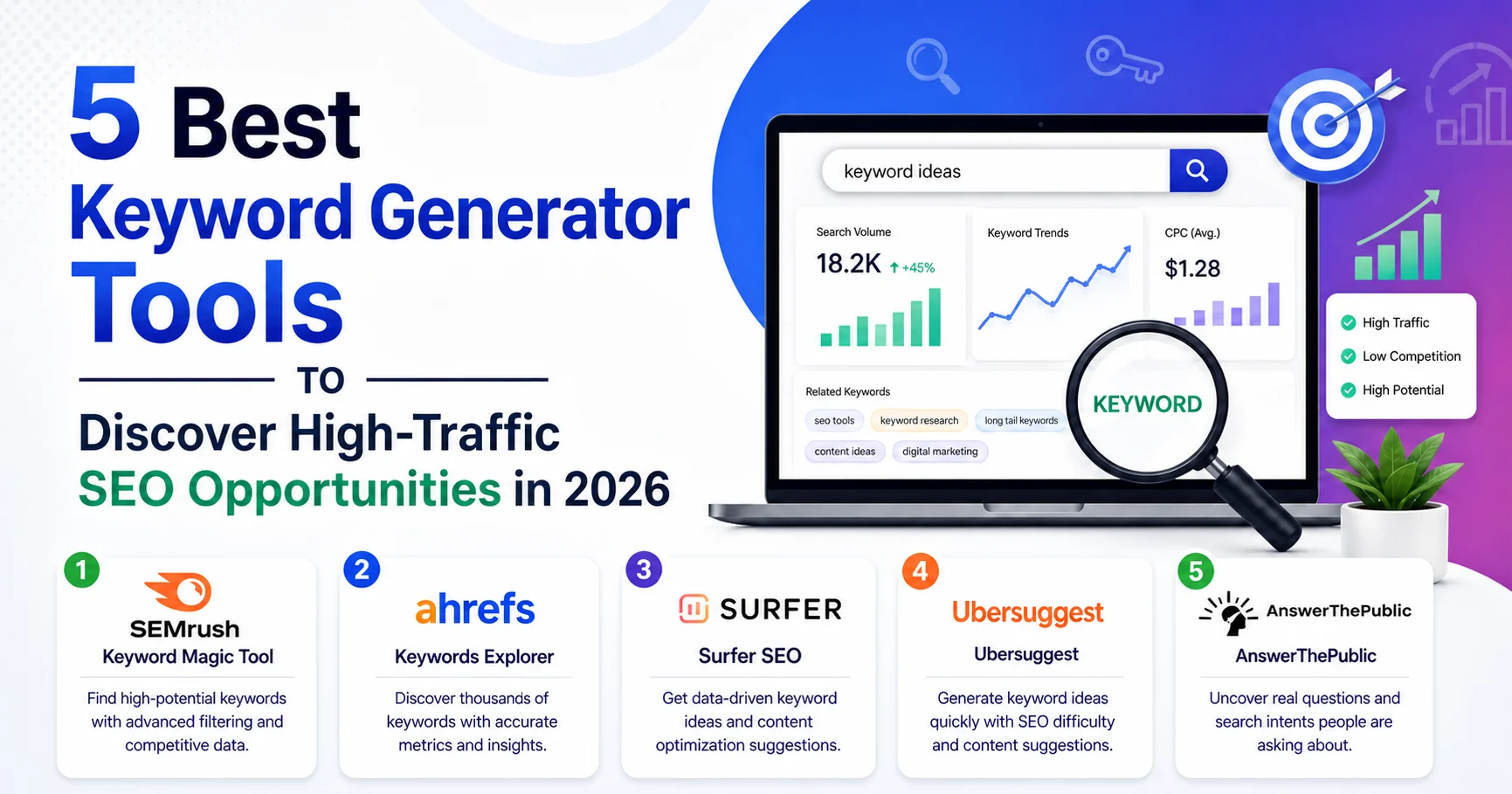
To answer your immediate question: the absolute best keyword generator tools to uncover high-traffic SEO opportunities in 2026 are Semrush, Ahrefs, Surfer SEO, Ubersuggest, and AnswerThePublic. Each of these platforms offers a unique approach to data, catering to different budgets and specific SEO workflows.
But simply knowing the names isn’t enough. You need to know how to use them to actually drive traffic.
In this comprehensive, no-fluff guide, I will walk you through my personal experiences with the top 5 tools on the market. I will break down their exact features, reveal the hidden difficulties I encountered while using them, and show you how to leverage a modern keyword generator to dominate the 2026 search landscape. By the end of this article, you will have the definitive answer to your SEO research needs and won’t need to search Google for another guide on this topic.
Why a Good Keyword Generator is Crucial in 2026
Before we dive into the tools, we need to address the elephant in the room: search behavior has fundamentally changed.
According to a 2026 report by Search Engine Journal, over 65% of informational queries are now resolved directly within AI-generated snippets, leaving traditional organic listings fighting for the remaining clicks. This means a basic keyword generator that only spits out search volume is practically useless today.
You need a tool that understands semantic search, user intent, and content gaps. You need to find the “high-traffic SEO opportunities” that AI hasn’t fully cannibalized yet—specifically, highly specific long-tail queries, complex problem-solving questions, and localized intent keywords.
“In 2026, we don’t just optimize for keywords; we optimize for the questions behind the keywords. Your keyword generator must reflect human curiosity, not just database metrics.”
When I started my SEO career, I relied on free, basic tools. I quickly learned that inaccurate data leads to wasted content creation. Investing in a premium keyword generator is not an expense; it is the foundation of your entire digital strategy. Let’s look at the 5 best options available today.
1. Semrush: The All-in-One Powerhouse for Intent-Driven SEO

Semrush is an all-in-one digital marketing and SEO platform designed to help businesses, marketers, and website owners improve their online visibility and attract more organic traffic. It offers a wide range of tools for keyword research, competitor analysis, backlink monitoring, site audits, rank tracking, and content optimization. Its Keyword Magic Tool helps users discover relevant search terms, analyze search volume, evaluate keyword difficulty, and identify long-tail opportunities for content creation. Semrush also provides tools for paid advertising, social media management, and content marketing, making it useful beyond traditional SEO. With its extensive data and competitive analysis features, Semrush helps digital marketers make informed decisions, identify growth opportunities, and develop more effective online marketing strategies.
If you ask any seasoned SEO agency what their daily driver is, Semrush will likely be the answer. Its keyword generator capabilities are housed within the legendary “Keyword Magic Tool,” and in 2026, it remains the undisputed king of comprehensive data.
My Personal Experience with Semrush
When I first logged into Semrush years ago, I was genuinely overwhelmed by the sheer volume of data. The interface is dense. However, once I learned how to use the advanced filtering, it became my most valuable asset. Recently, I used it to find high-traffic opportunities for a B2B SaaS client. By filtering the keyword generator results by “Intent: Informational” and “KD% (Keyword Difficulty) under 30”, I found a cluster of long-tail keywords that were generating zero traffic for our competitors but had a combined monthly search volume of 14,000.
The difficulty I often face with Semrush is the credit system for certain API integrations and the steep learning curve for beginners. But the depth of data is unmatched.
Key Features for 2026
- Keyword Magic Tool: Generates up to 10 billion keywords, grouped semantically.
- Intent Classification: Automatically tags keywords as Informational, Navigational, Commercial, or Transactional.
- SERP Features Analysis: Shows you exactly what AI Overviews, PAA (People Also Ask), and featured snippets are present for a term.
- Keyword Gap: Allows you to compare your site against up to 4 competitors to find missed opportunities.
Pros and Cons
Pros:
- Unmatched database size and accuracy.
- Excellent intent filtering crucial for 2026 AI search.
- Deep integration with their content marketing and on-page SEO tools.
Cons:
- Expensive for freelancers and small businesses.
- Interface can be intimidating for absolute beginners.
Pricing
Starts at $139.95/month for the Pro plan.
User Review Rating
⭐⭐⭐⭐⭐ (4.8 / 5) – Users praise the data accuracy but note the high price point.
2. Ahrefs: The Authority on Content and Backlink Synergy
Let’s be completely honest: Ahrefs is a phenomenal tool. For years, it has been the gold standard for backlink analysis, keyword research, and competitive intelligence. But let’s also be realistic about the elephant in the room: the pricing. Over the years, Ahrefs has shifted its pricing model, removed its standalone tools, and pushed users into expensive, bundled subscriptions. For freelancers, small agencies, and growing startups, this financial barrier is becoming impossible to ignore.
Ahrefs started as a backlink checker, but its Keywords Explorer has evolved into one of the most reliable keyword generator tools on the market. While Semrush focuses heavily on PPC and broad marketing data, Ahrefs is laser-focused on organic search and content strategy.
My Personal Experience with Ahrefs
I have a soft spot for Ahrefs because of its “Parent Topic” feature. Many keyword generator tools treat every keyword as an isolated island. Ahrefs tells you if ranking for a specific long-tail keyword will also naturally rank you for a broader head term. I once spent weeks trying to rank for three different variations of a software review. Ahrefs showed me they all shared the same “Parent Topic.” I consolidated them into one mega-guide, and my traffic tripled.
The main drawback I’ve noticed recently is that Ahrefs’ click-stream data, while highly accurate, sometimes lags a few weeks behind sudden viral trends compared to Semrush.
Key Features for 2026
- Keywords Explorer: Features unique metrics like “Clicks” and “Return Rate” (how often people search the same term multiple times).
- Parent Topic: Prevents keyword cannibalization by showing the broader topic you need to target.
- Content Explorer: Helps you find high-traffic topics that are already proven to attract backlinks.
- Traffic Potential (TP): A brilliant metric that estimates the total traffic a #1 ranking page gets for all its ranked keywords, not just the main one.
Pros and Cons
Pros:
- Best-in-class “Traffic Potential” metric.
- Incredible UI/UX; very intuitive for content creators.
- Excellent for finding content gaps and link-building opportunities.
Cons:
- The credit-based system can be frustrating if you do massive daily research.
- Slightly smaller raw keyword database compared to Semrush.
Pricing
Starts at $129/month for the Lite plan.
User Review Rating
⭐⭐⭐⭐⭐ (4.7 / 5) – Highly rated for its intuitive interface and unique traffic metrics.
3. Surfer SEO: The AI Content & Keyword Optimizer

Surfer SEO is a powerful content optimization and on-page SEO platform designed to help users create content that ranks higher in search engine results. By analyzing top-performing pages for a target keyword, it provides data-driven recommendations on content structure, keyword usage, headings, and topic coverage. With features such as Content Editor, SERP Analyzer, keyword research, and AI-assisted writing, Surfer SEO helps marketers and content creators produce search-optimized content that aligns with user intent and drives organic traffic.
Surfer SEO is not a traditional standalone keyword generator like the first two. Instead, it is an on-page optimization tool that includes a powerful, AI-driven keyword research module. In 2026, where AI content is everywhere, Surfer helps you ensure your content actually meets the semantic requirements of the search engines.
My Personal Experience with Surfer SEO
I use Surfer when I already have a general topic but need to find the exact semantic keyword generator terms to include in my brief. When I tested their Keyword Research tool for a recent e-commerce guide, it didn’t just give me search volume; it gave me a “Content Score” benchmark. It told me exactly how many words, images, and specific NLP (Natural Language Processing) terms the current top 10 results were using.
The difficulty here is that Surfer is strictly for on-page SEO. If you need deep technical SEO data or backlink analysis, you will need to pair it with another tool.
Key Features for 2026
- AI-Powered Keyword Research: Generates clusters based on semantic relevance, not just exact match.
- Content Editor: Real-time optimization as you write, ensuring you hit the right keyword density and semantic terms.
- Audit Tool: Compares your live page against top-ranking competitors.
- SERP Analyzer: Breaks down the exact structure of the current top 10 results.
Pros and Cons
Pros:
- Bridges the gap between finding a keyword and actually ranking for it.
- Incredible for optimizing content for AI Overviews and NLP algorithms.
- Very user-friendly for writers and content marketers.
Cons:
- Lacks deep technical SEO and backlink data.
- The keyword research module is best used as a supplement to a primary tool like Ahrefs or Semrush.
Pricing
Starts at $109/month for the Essential plan.
User Review Rating
⭐⭐⭐⭐½ (4.6 / 5) – Loved by content teams, but some wish it had more standalone research features.
4. Ubersuggest: The Budget-Friendly Veteran
Ubersuggest is an SEO and keyword research tool designed to help website owners, marketers, and content creators improve their search engine visibility. It provides keyword suggestions, search volume estimates, SEO difficulty scores, and content ideas to help users identify valuable opportunities for organic traffic. Ubersuggest also offers competitor analysis, backlink data, site audits, and domain overview reports, allowing users to evaluate website performance and discover areas for improvement. Its keyword research features are particularly useful for finding long-tail keywords and planning SEO-focused content. With its user-friendly interface and range of optimization tools, Ubersuggest is a practical option for bloggers, small businesses, and digital marketers looking to strengthen their SEO strategies and grow organic traffic.

Created by Neil Patel, Ubersuggest has been a staple for beginners and small businesses for years. If you are looking for a highly accessible, easy-to-use keyword generator that won’t break the bank, this is your go-to option.
My Personal Experience with Ubersuggest
I often recommend Ubersuggest to my junior team members when they are just learning the ropes of SEO keyword research. It provides a clean, straightforward interface. Recently, I used it to do a quick competitor analysis for a local plumbing client. Within 5 minutes, I had a list of high-traffic, low-competition local keywords.
However, I must be transparent: the data is not as granular as Semrush or Ahrefs. The “Keyword Difficulty” scores can sometimes feel a bit arbitrary, and the tool occasionally misses hyper-specific, low-volume long-tail keywords. It is a fantastic starting point, but scaling enterprises will eventually outgrow it.
Key Features for 2026
- Keyword Ideas: Generates suggestions based on questions, prepositions, and comparisons.
- Content Ideas: Shows you the top-performing blog posts for a specific keyword, including social shares and estimated backlinks.
- Top SEO Pages: Reveals which pages on a competitor’s site are driving the most organic traffic.
- Chrome Extension: A free, lightweight extension that gives you quick data while browsing the web.
Pros and Cons
Pros:
- Extremely affordable and offers a generous free tier.
- Very intuitive, perfect for beginners and small business owners.
- Includes basic site audit and backlink data in the same dashboard.
Cons:
- Data accuracy and depth lag behind enterprise tools.
- Keyword difficulty metrics can sometimes be misleading.
Pricing
Starts at $29/month (or a very affordable lifetime deal occasionally available).
User Review Rating
⭐⭐⭐⭐ (4.3 / 5) – Highly praised for its value for money, though power users note data limitations.
5. AnswerThePublic: The Question & Intent Master

AnswerThePublic is a powerful keyword research and content discovery tool that helps marketers, SEO professionals, bloggers, and businesses uncover the questions and topics people are actively searching for online. By collecting autocomplete data from major search engines, it organizes search queries into categories such as questions, comparisons, prepositions, and related keywords, making it easy to understand user intent and identify valuable content opportunities. The platform is particularly useful for finding long-tail keywords, generating blog ideas, improving SEO strategies, and creating content that aligns with real audience interests. Whether you’re planning a content marketing campaign or optimizing your website for organic search, AnswerThePublic provides actionable insights to help you attract more targeted traffic and improve search engine rankings.
AnswerThePublic (now part of NP Digital) takes a completely different approach. It doesn’t focus on raw search volume; it focuses on human psychology. It is the ultimate long-tail keyword generator for understanding exactly what questions your audience is asking.
My Personal Experience with AnswerThePublic
I use AnswerThePublic almost exclusively during the brainstorming and content mapping phase. When I need to write a comprehensive guide, I plug in a broad term, and the visualizer maps out every “who, what, where, when, why, and how” question associated with it.
The main difficulty I’ve encountered is that the free version is highly restricted (only a few searches a day), and the tool doesn’t provide the deep filtering capabilities of a traditional database. You use this tool to find the angles, and then you take those angles to Semrush or Ahrefs to validate the volume.
Key Features for 2026
- Visual Search Insights: Generates a beautiful, easy-to-read mind map of questions and prepositions.
- Question Generator: Perfect for finding “People Also Ask” (PAA) opportunities and voice search queries.
- Alphabet Soup Method: Automates the process of typing your keyword + every letter of the alphabet.
- Data Downloads: Allows you to export your search queries into CSV for further analysis.
Pros and Cons
Pros:
- Unbeatable for understanding user intent and generating content ideas.
- Excellent for voice search and featured snippet optimization.
- Highly visual and easy to share with clients or content teams.
Cons:
- Lacks robust filtering and deep metric data (like CPC or precise KD%).
- The free version is very limited.
Pricing
Starts at $11/month for the Individual plan.
User Review Rating
⭐⭐⭐⭐½ (4.4 / 5) – Users love the visual interface and idea generation, but note it must be paired with other tools.
Comparison Table: Which Keyword Generator is Right for You?
To help you make a quick decision, here is a professional comparison of the 5 best keyword generator tools reviewed above.
| Tool | Best Ideal For | Ease of Use | Data Depth | User Rating | Starting Price |
|---|---|---|---|---|---|
| Semrush | Agencies & Comprehensive SEO | ⭐⭐⭐ | ⭐⭐⭐⭐⭐ | ⭐⭐⭐⭐⭐ (4.8) | $139.95/mo |
| Ahrefs | Content Creators & Link Builders | ⭐⭐⭐⭐ | ⭐⭐⭐⭐⭐ | ⭐⭐⭐⭐⭐ (4.7) | $129.00/mo |
| Surfer SEO | On-Page Optimization & AI Content | ⭐⭐⭐⭐⭐ | ⭐⭐⭐⭐ | ⭐⭐⭐⭐½ (4.6) | $109.00/mo |
| Ubersuggest | Beginners & Small Businesses | ⭐⭐⭐⭐⭐ | ⭐⭐⭐ | ⭐⭐⭐⭐ (4.3) | $29.00/mo |
| AnswerThePublic | Brainstorming & Long-Tail Intent | ⭐⭐⭐⭐⭐ | ⭐⭐ | ⭐⭐⭐⭐½ (4.4) | $11.00/mo |
How to Choose the Right Keyword Generator for Your Needs
Choosing the right keyword generator depends entirely on your current business stage, budget, and primary SEO goals. Here is my practical advice on how to choose:
- For Enterprise Agencies & E-commerce: Go with Semrush. The sheer volume of data, combined with intent filtering and local SEO features, will justify the monthly cost. You need the granular data to manage multiple clients and massive product catalogs.
- For Content-Led Businesses & SaaS: Choose Ahrefs. If your primary growth engine is blog traffic and organic authority, Ahrefs’ Traffic Potential and Parent Topic features will save you from creating redundant content.
- For Solo Bloggers & Local Businesses: Start with Ubersuggest. It provides 80% of the value of the enterprise tools for 20% of the price. It is more than enough to find local keywords and basic content ideas.
- For Content Teams & Copywriters: Pair your main tool with Surfer SEO. Once your keyword generator gives you the target term, Surfer ensures the actual article is optimized to rank.
- For Podcasters, YouTubers, & Idea Generation: Use AnswerThePublic. It is the best tool for finding the exact questions your audience is struggling with, which you can then answer in your media.
⚠️ Important Warning for 2026 SEO: Do not fall into the trap of “Keyword Stuffing.” Just because a keyword generator gives you a list of 50 related terms does not mean you should cram them all into one article. Search engines in 2026 penalize unnatural language. Pick one primary keyword, 3-4 secondary semantic terms, and write naturally for the human reader.
Practical Summary & Step-by-Step Checklist
Finding high-traffic SEO opportunities is a systematic process. Here is your actionable checklist to use with your chosen keyword generator today:
The 2026 Keyword Research Checklist
- Step 1: Define Your Core Topics. Don’t start with keywords; start with the 3 to 5 broad pillars your business covers.
- Step 2: Generate the Raw List. Input your pillars into your keyword generator (e.g., Semrush Keyword Magic Tool or Ahrefs Keywords Explorer).
- Step 3: Filter for Intent and Difficulty. Filter out keywords with a Keyword Difficulty (KD) higher than your site’s current Domain Authority. Filter by intent (e.g., Informational for blog posts, Transactional for product pages).
- Step 4: Check the “Clicks” Metric. Ensure the keyword actually generates clicks. A high search volume with near-zero clicks means the answer is fully satisfied in the AI Overview or SERP features.
- Step 5: Analyze the SERP. Manually search your top 5 chosen keywords. Look at the “People Also Ask” section. Are there questions your content can answer better than the current results?
- Step 6: Group and Cluster. Group similar keywords together. One comprehensive page should target a cluster of related keywords, not just one exact-match term.
- Step 7: Map to Content. Assign each keyword cluster to a specific URL on your site. Ensure you are not cannibalizing your own rankings.
Frequently Asked Questions (FAQs)
1. Is a free keyword generator enough for SEO in 2026?
Free tools like Google Keyword Planner or the free version of Ubersuggest are great for beginners. However, they lack advanced intent filtering, accurate click-through data, and competitor gap analysis. If you are serious about generating high-traffic SEO opportunities, investing in a premium keyword generator is highly recommended.
2. How often should I use a keyword generator?
SEO is not a one-time task. You should use your keyword generator continuously. Conduct deep research quarterly for new content pillars, and do a quick review monthly to identify trending topics, seasonal shifts, or new content gaps left by your competitors.
3. What is the best keyword generator for long-tail keywords?
For finding highly specific, low-competition long-tail keywords, AnswerThePublic is excellent for brainstorming the actual questions users ask. For validating the search volume and difficulty of those long-tail terms, Ahrefs and Semrush are the industry standards.
4. How do AI Overviews affect keyword generator data?
AI Overviews (AIO) have changed how we interpret search volume. A keyword might have 10,000 monthly searches, but if an AI Overview answers it instantly, you might only get 50 clicks. This is why using a keyword generator that provides “Clicks” data (like Ahrefs) or SERP feature analysis (like Semrush) is crucial in 2026.
5. Can I use multiple keyword generator tools together?
Absolutely. In fact, it is a best practice. Many top SEO professionals use AnswerThePublic to brainstorm content angles, Semrush to validate the data and check competitor gaps, and Surfer SEO to optimize the final draft. Combining tools gives you a 360-degree view of the search landscape.
Conclusion
The landscape of search engine optimization has evolved dramatically, but the core principle remains the same: you cannot rank if you do not know what your audience is looking for.
As we have explored in this guide, the 5 best keyword generator tools—Semrush, Ahrefs, Surfer SEO, Ubersuggest, and AnswerThePublic—each offer unique strengths. Whether you need the enterprise-level data depth of Semrush, the content-focused metrics of Ahrefs, or the budget-friendly accessibility of Ubersuggest, there is a perfect tool for your specific needs.
Remember, a tool is only as good as the strategy behind it. Use the checklist provided, focus heavily on user intent, and always prioritize creating genuinely helpful content over chasing arbitrary search volume metrics.
Stop guessing what your audience wants. Pick the right keyword generator from this list, dive into the data, and start uncovering those high-traffic SEO opportunities today. Your future organic traffic will thank you.