Arena AI Review: Features, Best AI Model Rankings, Pricing & Everything You Need to Know

Introduction
If you’ve spent any time in AI circles lately, you’ve probably stumbled across the name Arena AI — and wondered what exactly makes it different from the dozens of AI platforms already fighting for your attention. Is it a chatbot? A benchmark tool? A research platform? The honest answer: it’s a bit of all three, and that’s precisely what makes it interesting.
Arena AI (also widely known as LMSYS Chatbot Arena or the broader Chatbot Arena ecosystem) has quietly become one of the most trusted, community-driven AI model evaluation platforms on the internet. Rather than relying on lab-generated benchmarks that few people understand, Arena AI lets real users compare large language models (LLMs) side by side — anonymously, fairly, and for free.
In this complete guide, you’ll find:
- ✅ A clear explanation of what Arena AI is and how it works
- ✅ A breakdown of all key features (including what makes them unique in 2026)
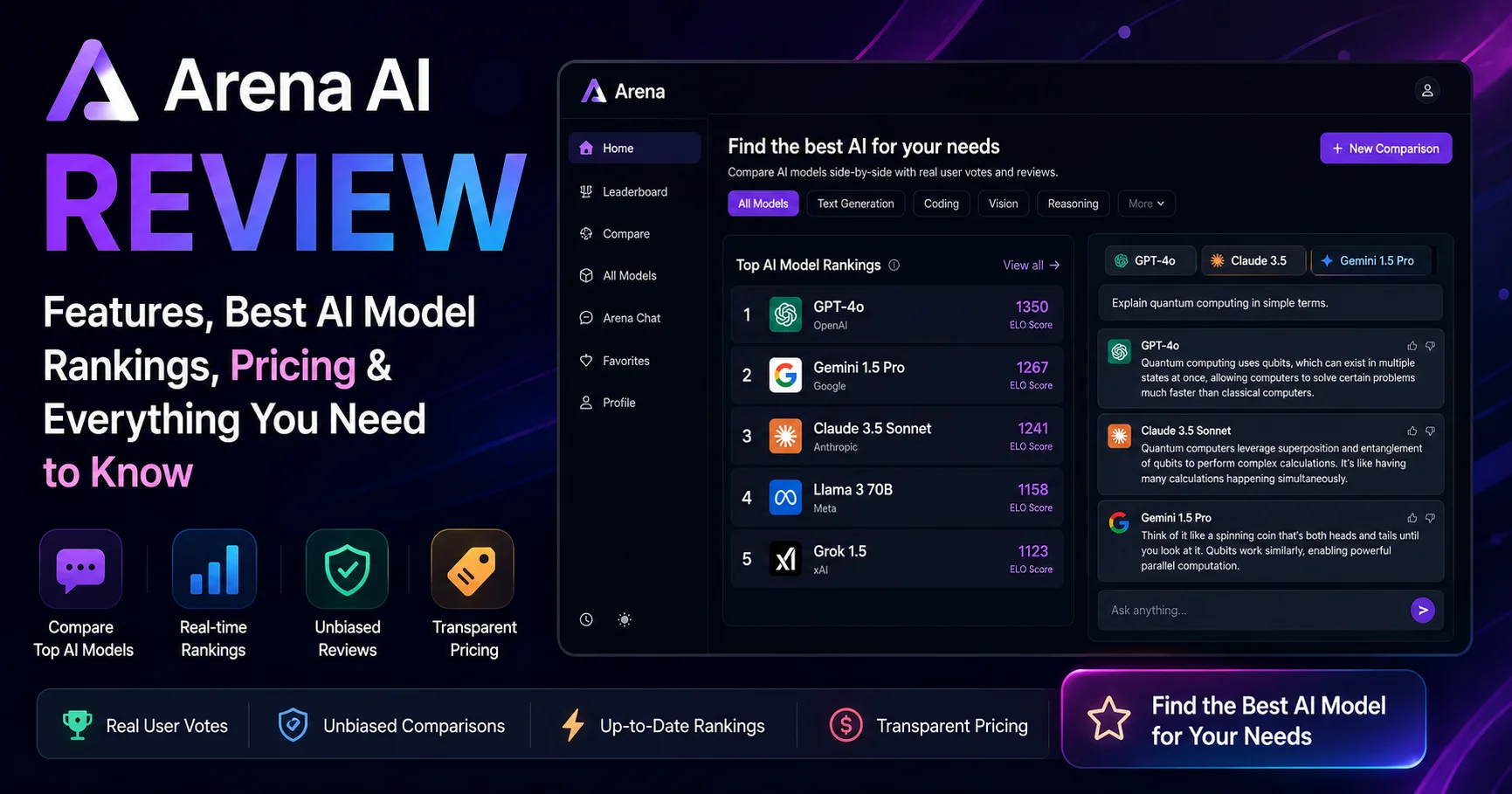
- ✅ The current AI model leaderboard and rankings explained
- ✅ Honest pricing information
- ✅ Real pros and cons based on hands-on experience
- ✅ A comparison table, checklist, and FAQs
Whether you’re a developer evaluating LLMs for a project, a researcher comparing model outputs, or just an AI-curious person who wants to see which model wins in a head-to-head battle — this guide is for you.
What Is Arena AI? A Plain-English Explanation

Arena AI, most prominently recognized through the LMSYS Chatbot Arena, is a pioneering crowdsourced benchmarking platform dedicated to evaluating and ranking Large Language Models (LLMs) through real-world human interaction. Unlike traditional automated tests, the platform employs a blind A/B testing mechanism where users submit prompts to two anonymous AI models simultaneously and vote on which response is superior. This continuous, human-in-the-loop feedback generates a dynamic, Elo-based leaderboard that captures nuanced qualities such as logical reasoning, creativity, coding accuracy, and instruction-following. By reflecting authentic user preferences rather than just rote memorization of test sets, Arena AI has established itself as the industry’s gold standard for developers and researchers to measure the true capabilities, alignment, and rapid evolution of generative AI models.
Arena AI is a crowdsourced AI model evaluation platform where users submit prompts to two anonymous AI models simultaneously, compare their responses, and vote on which one they prefer. The results feed into a continuously updated leaderboard that ranks models using the Elo rating system — the same method used to rank chess players.
The platform was originally developed by the LMSYS (Large Model Systems Organization), a collaborative research group founded by researchers from UC Berkeley, CMU, Stanford, and UCSD. Since its launch, it has collected over 2 million human preference votes, making its leaderboard arguably the most statistically robust AI benchmark available to the public in 2026.
💡 Key insight: Most AI benchmarks are designed by the labs building the models. Arena AI’s leaderboard is built by everyday users — which makes it uniquely free from conflicts of interest.
In 2026, the platform has expanded significantly. It now includes:
- A public battle arena (anonymous pairwise comparison)
- A direct model chat option (chat with specific models by name)
- A structured leaderboard with category-based rankings
- An API access layer for developers
- New multimodal arena capabilities (vision + text)
How Arena AI Works: Step-by-Step
Arena AI works differently from a traditional AI chatbot. Instead of relying on a single model, the platform allows users to test, compare, and evaluate leading AI models through real-world prompts. Its best-known feature is Battle Mode, where two anonymous AI models generate answers to the same prompt and the user decides which response is better.
These human preference votes are then aggregated to help build Arena’s public AI leaderboards. This approach makes Arena particularly useful for comparing models based on how they perform in real situations rather than relying exclusively on fixed benchmark tests. (Arena AI)
Step 1: Enter Your Prompt
The process begins by entering a prompt into Arena AI. A prompt can be a question, writing request, coding problem, reasoning task, brainstorming challenge, or another type of instruction you want an AI model to handle.
For example, you could ask an AI to:
- Explain a difficult technical concept.
- Write or improve a piece of content.
- Solve a programming problem.
- Analyze information.
- Generate creative ideas.
- Answer a complex reasoning question.
Arena also supports different types of AI tasks. For example, users interested in image generation can select the appropriate image-generation option rather than using the standard text interface. (Arena AI)
The important difference is that in Battle Mode, you are not initially choosing the AI model yourself. Arena selects the competing models behind the scenes.
Step 2: Arena Selects Two Anonymous AI Models
Once you submit your prompt in Battle Mode, Arena sends it to two AI models.
The identities of those models remain hidden while you evaluate their answers. Instead of seeing recognizable model names that could influence your decision, you simply receive two responses.
This anonymity is an important part of Arena’s evaluation system because it helps reduce brand bias. A user cannot intentionally choose an answer simply because it comes from a company or model they already prefer. (Arena Help Center)
For example, a battle could theoretically involve models from different AI developers, but you evaluate only the quality of their outputs before discovering which models produced them.
Step 3: Both Models Answer the Same Prompt
The two selected models independently process your prompt and generate their responses.
Arena displays the answers side by side, making it much easier to compare them directly.
At this stage, you can evaluate characteristics such as:
- Accuracy
- Relevance
- Reasoning quality
- Clarity
- Completeness
- Writing quality
- Following instructions
- Creativity
- Usefulness
This is one of Arena AI’s biggest advantages. Instead of opening several separate AI platforms, copying the same prompt into each one, and manually comparing the results, Arena places competing responses together in a single interface.
Step 4: Compare the Two Responses
Next, carefully examine both answers and determine which one better satisfies your original request.
There is no universal definition of the “best” response. Your decision can depend on the task.
For example, when testing a coding question, you might prioritize correctness and efficiency. For creative writing, style and originality could matter more. For research-related questions, factual accuracy and clarity may be more important.
Arena’s system is intentionally based on human preferences, meaning users evaluate models according to the usefulness of their responses in realistic situations. (Arena AI)
This approach differs from many traditional AI benchmarks, where models complete a predefined collection of standardized questions.
Step 5: Vote for the Better AI Response
After comparing the answers, you can cast your vote.
Your vote tells Arena which response you preferred. These votes are important because they contribute to the data used to evaluate AI model performance.
Arena explains that only votes submitted while the competing models are still anonymous contribute to its official Battle Mode rankings. Votes made after model identities have been revealed do not affect the leaderboard. (Arena AI)
This prevents users from changing their judgment based on the reputation of a particular AI provider.
Step 6: Discover Which Models Generated the Answers
After submitting your vote, Arena reveals the identities of the two competing models.
This creates one of the platform’s most interesting experiences because your preferred answer may not always come from the model you expected.
You might discover that a less familiar model performed better for a particular task than a widely known competitor.
Arena also works with AI providers testing models that have not yet been publicly released. As a result, some experimental models may temporarily appear under codenames or aliases during evaluations. (Arena AI)
This gives the Arena community an opportunity to evaluate emerging AI models using real prompts.
Step 7: Continue the Conversation or Start Another Battle
Once the models have been revealed, you can continue interacting within the conversation or start another comparison.
Arena allows users to submit multiple prompts and participate in multiple battles. When a new matchup begins, the competing models can be anonymously resampled. (Arena AI)
Running several comparisons is often more informative than relying on a single battle because AI models have different strengths.
One model may perform exceptionally well at coding while another may be better for writing, reasoning, mathematical tasks, or creative work.
Step 8: Arena Aggregates Community Votes
Behind the interface, Arena collects large numbers of preference comparisons from its community.
Individual votes become part of a much larger dataset showing how frequently users prefer one model over another.
Instead of treating one person’s opinion as definitive, Arena aggregates votes across many different users, prompts, models, and use cases.
According to Arena, the platform uses a Bradley-Terry statistical model for its traditional pairwise leaderboards. Bradley-Terry is designed specifically for situations in which alternatives are repeatedly compared against one another. (Arena AI)
In simplified terms:
Model A vs. Model B → users vote → thousands of comparisons accumulate → statistical ratings are calculated → models receive leaderboard positions.
The more comparison data Arena collects, the more information it has for estimating how models perform relative to their competitors.
Step 9: Arena Calculates Model Scores and Rankings
The voting data is transformed into Arena scores and rankings.
Arena’s leaderboards can display information such as:
Rank: The model’s current position compared with competing models.
Rank Spread: The possible range of positions associated with statistical uncertainty.
Arena Score: A rating calculated from battle outcomes.
Votes: The number of comparisons involving the model.
Confidence Interval: An indication of statistical uncertainty surrounding the model’s score. (Arena Help Center)
This additional statistical information is important because small differences between models do not necessarily mean that one is unquestionably superior to another.
Step 10: Explore the Arena AI Leaderboards
Users can then visit Arena’s leaderboards to see how models compare.
Arena now covers multiple categories rather than providing only one universal ranking. Its leaderboard ecosystem includes evaluations across areas such as text, images, vision, search, and agent-based AI experiences. (Arena AI)
Within the Text Arena, users can also examine performance across different types of tasks instead of focusing only on an overall score.
This makes the leaderboard useful for answering a more practical question:
Which AI model performs best for the task I actually want to accomplish?
That can be more useful than simply asking which model occupies the highest overall position.
Battle Mode vs. Side-by-Side Mode vs. Direct Mode
Arena AI is not limited to anonymous battles. The platform also provides other ways to interact with models.
Battle Mode gives you two anonymous models. You compare their responses and vote before their identities are revealed. Eligible votes from this mode contribute to the public rankings.
Side-by-Side Mode lets you deliberately choose specific models and compare their responses directly. Because the models are known rather than anonymous, votes from this mode do not contribute to the official public leaderboard.
Direct Mode lets you interact with a specific model without running a head-to-head battle. There is no leaderboard vote in this mode. (Arena AI)
Therefore, Battle Mode is best when you want a relatively unbiased comparison, while Side-by-Side Mode is more convenient when you already know exactly which models you want to test.
A Simple Example of How Arena AI Works
Imagine you submit the following prompt:
“Create a three-day content marketing strategy for a new productivity app.”
Arena anonymously sends the prompt to two models.
Model A creates a detailed strategy covering blog posts, social media, email marketing, and performance metrics.
Model B provides a shorter plan with stronger creative campaign ideas.
You compare the two responses without knowing which AI systems produced them.
If Model A better satisfies your needs, you vote for Response A.
Arena then reveals the identities of both models.
Your anonymous preference becomes part of the comparison data used by Arena’s evaluation system. Across a very large number of similar battles from different users, these preferences help determine model ratings and leaderboard positions.
Why Arena AI’s Evaluation System Matters
The key idea behind Arena AI is surprisingly simple:
Let real people give real prompts to competing AI models and decide which answers they actually prefer.
Traditional benchmarks remain useful, but standardized tests cannot represent every way people interact with AI.
Arena complements those benchmarks with continuously collected human feedback from real-world prompts. Because models are anonymous during Battle Mode voting, the methodology also attempts to reduce the influence of brand recognition on user preferences. (Arena AI)
Arena has continued expanding this concept as AI systems evolve. For example, its Agent Arena evaluates agentic systems differently from classic Battle Mode: rather than relying solely on pairwise votes, its agent leaderboard uses signals related to real task execution, including task success, user feedback, steerability, recovery from tool errors, and tool hallucination behavior. (Arena Help Center)
In Short: Arena AI Workflow
The basic Arena AI workflow can be summarized as:
Enter a prompt → Two anonymous models respond → Compare the answers → Vote for your preferred response → Discover the model identities → Votes are aggregated → Statistical ratings are calculated → Leaderboards are updated.
This combination of anonymous comparisons, human preferences, statistical ranking, and constantly changing real-world prompts is what makes Arena AI one of the most interesting platforms for evaluating and comparing today’s leading AI models.
Cette section peut très bien devenir l’un des H2 principaux de ton article “Arena AI Review: Features, AI Model Rankings, Pricing & Everything You Need to Know”.
Arena AI Key Features in 2026

The robustness of Arena AI lies in its diverse array of features. It is not a one-trick pony; it is a versatile Swiss Army knife for the digital age. Let us explore the specific functionalities that make this platform so powerful.
After spending considerable time on the platform, here’s an honest breakdown of every major feature:
1. 🥊 Battle Arena (Anonymous Pairwise Comparison)
The core feature. Two models, one prompt, zero bias. This is where Arena AI shines brightest. The simplicity is intentional — it forces you to judge the output, not the brand.
What works well: The interface is clean, fast, and distraction-free. You can compare models on virtually any type of task.
One limitation I noticed: You can’t filter which two models get paired against each other in the anonymous mode — that’s by design, to maintain randomness and statistical integrity.
2. 📊 The Elo Leaderboard
The leaderboard is updated in near-real time and is openly accessible. As of mid-2026, it tracks over 100 AI models across multiple categories:
- Overall ranking
- Coding tasks
- Math reasoning
- Creative writing
- Instruction following
- Multimodal tasks (image + text)
Each model’s Elo score is calculated based on win/loss rates across thousands of battles. Models need a minimum number of votes to appear on the leaderboard, which prevents newly launched models with only 10 battles from gaming the rankings.
3. 💬 Direct Chat Mode
Want to chat with a specific model without the competitive format? Arena AI also offers a straightforward chat interface where you can select a model by name and have a normal conversation. This is useful for:
- Testing a specific model before integrating it via API
- Comparing your own outputs against a reference model
- Casual experimentation without the pressure of voting
4. 🖼️ Vision Arena (Multimodal Comparisons)
Introduced more formally in 2025 and refined in 2026, the Vision Arena lets you upload an image and have two multimodal models interpret, describe, or analyze it. This is increasingly important as models like GPT-4o, Claude 3.5 Sonnet, and Gemini 1.5 Pro all compete heavily in vision benchmarks.
5. 🔌 API Access for Developers
Researchers and developers can access aggregated leaderboard data and some API endpoints to integrate Arena AI data into their own workflows. The API layer is particularly useful for teams conducting ongoing model evaluation at scale.
6. 📁 Data Transparency & Research Papers
One feature that separates Arena AI from commercial review platforms: they publish their methodology. The team regularly releases research papers, datasets, and statistical analyses. If you want to understand why a model ranks where it does, the data is there. This level of transparency is rare and genuinely valuable.
Arena AI Model Rankings 2026: Who’s on Top?
⚠️ Important note: Elo scores change daily as new votes come in. The rankings below reflect the general competitive landscape in mid-2026 and are meant to give you a directional sense of the leaderboard — always check the live leaderboard at lmarena.ai for the most current standings.
| Rank | Model | Organization | Approximate Elo | Strengths |
|---|---|---|---|---|
| 🥇 1 | GPT-4o (latest) | OpenAI | ~1,350+ | All-around, instruction following |
| 🥈 2 | Claude 3.5 Sonnet | Anthropic | ~1,340+ | Writing, reasoning, safety |
| 🥉 3 | Gemini 1.5 Pro | Google DeepMind | ~1,320+ | Long context, multimodal |
| 4 | Llama 3.1 405B | Meta | ~1,295+ | Open-source leader |
| 5 | Mistral Large 2 | Mistral AI | ~1,270+ | Efficiency, multilingual |
| 6 | Command R+ | Cohere | ~1,250+ | Enterprise, RAG tasks |
| 7 | Qwen2-72B | Alibaba Cloud | ~1,240+ | Coding, Chinese language |
| 8 | DeepSeek-V2.5 | DeepSeek | ~1,230+ | Math, coding, low cost |
Key observations from the 2026 leaderboard:
- The gap between the top 3 models has narrowed significantly compared to 2024
- Open-source models (especially Meta’s Llama 3.1 family) are genuinely competitive with proprietary models
- DeepSeek models have surprised the community with strong performance at a fraction of the cost
- Multimodal capabilities increasingly influence overall rankings
Arena AI Pricing: What Does It Cost?
This is where Arena AI genuinely stands out from most platforms: the core Chatbot Arena experience is completely free.
| Feature | Cost |
|---|---|
| Battle Arena (anonymous pairwise) | Free |
| Direct model chat (limited models) | Free |
| Leaderboard access | Free |
| Vision Arena | Free |
| API access (research/developer) | Contact team |
| Premium model access via API | Pay per model (varies by provider) |
There is no subscription fee, no credit card required to start, and no usage limits for the core voting and chat features. The platform is funded through research grants, academic partnerships, and increasingly through commercial partnerships with AI labs who want their models included and evaluated.
💡 Practical tip: If you want to use specific frontier models (like GPT-4o or Claude 3.5) repeatedly in Direct Chat mode, you may eventually hit rate limits. For heavy usage, you’d access those models directly through their respective APIs.
Honest Pros and Cons of Arena AI
After extensive personal use, here’s the unfiltered assessment:
✅ What Arena AI Does Really Well
- Unbiased comparison methodology — the anonymous battle format is genuinely clever and scientifically sound
- Massive dataset — over 2 million votes means the statistics are meaningful, not noise
- Completely free for most use cases
- Transparent methodology — published papers, open data, no black-box scoring
- Regularly updated — new models get added quickly after launch
- Covers multiple task types — it’s not just one benchmark, it’s a family of them
- Community-driven — anyone can contribute, which democratizes AI evaluation
❌ Limitations Worth Knowing
- You can’t control which models get paired in anonymous mode (intentional, but sometimes frustrating)
- Results depend on community quality — not all voters put equal effort into their evaluations
- Specialized tasks may be underrepresented — if your use case is niche (e.g., medical documentation or legal contract review), the general leaderboard may not perfectly predict performance for you
- No fine-tuned model support — you can’t test your own fine-tuned version of a model
- Interface is functional, not beautiful — it’s a research tool, not a polished SaaS product
Arena AI vs. Other AI Evaluation Tools
| Feature | Arena AI | OpenCompass | Hugging Face Open LLM | HELM |
|---|---|---|---|---|
| Human preference votes | ✅ Yes | ❌ No | ❌ No | ❌ No |
| Automated benchmarks | ⚠️ Partial | ✅ Yes | ✅ Yes | ✅ Yes |
| Free access | ✅ Yes | ✅ Yes | ✅ Yes | ✅ Yes |
| Multimodal support | ✅ Yes | ⚠️ Partial | ⚠️ Partial | ❌ Limited |
| Real-time updates | ✅ Yes | ⚠️ Partial | ⚠️ Partial | ❌ Infrequent |
| Transparency | ✅ High | ✅ High | ✅ High | ✅ High |
| Ease of use (non-technical) | ✅ Very easy | ❌ Technical | ⚠️ Moderate | ❌ Complex |
Bottom line: If you want to understand how real users perceive AI models in everyday tasks, Arena AI is the best tool available. If you need automated, reproducible benchmarks for academic research, HELM or Open LLM Leaderboard may complement it well.
User Reviews: What the Community Says About Arena AI
⭐⭐⭐⭐⭐ Marcus T., ML Engineer
“I’ve been using Arena AI for over a year. It’s become my first stop when a new model drops. The Elo system isn’t perfect, but nothing else gives you this much real-world human feedback data.”
⭐⭐⭐⭐ Priya S., Content Strategist
“As a non-technical user, I love how simple it is. I just type my prompt and vote. I’ve learned so much about which models are actually good at creative writing versus which ones just sound confident.”
⭐⭐⭐⭐ Daniel R., Researcher
“The data transparency is exceptional. I’ve cited their published datasets in papers. My only wish is that they added better filtering for domain-specific task categories.”
⭐⭐⭐ Sophie L., Startup Founder
“Useful as a starting point, but I still need to run my own evals for my specific use case. The leaderboard tells you general quality, not niche performance.”
Overall community rating: ⭐⭐⭐⭐ (4.3/5)
Who Should Use Arena AI?
Arena AI is ideal for:
- 🧑💻 Developers choosing an LLM for their application
- 🔬 AI researchers studying human preferences and model behaviors
- 📝 Content creators curious about which model produces the best writing
- 🎓 Students and educators learning about AI capabilities
- 🏢 Business owners evaluating AI tools before committing to a platform
- 😊 AI enthusiasts who simply enjoy exploring model differences
Arena AI is less suited for:
- Teams that need to evaluate proprietary or fine-tuned internal models
- Use cases requiring highly specialized domain benchmarks
- Organizations that need certified, auditable evaluation reports
Practical Checklist: Getting the Most from Arena AI
Use this checklist when you start using Arena AI for model evaluation:
- Visit lmarena.ai{:target=”_blank” rel=”nofollow”} — no account needed to start
- Begin with the Battle Arena to get unbiased impressions
- Test at least 5–10 different prompts before drawing conclusions
- Use diverse prompt types (coding, reasoning, creative, factual Q&A)
- Check the leaderboard by category, not just overall rank
- Use Direct Chat to dive deeper into a shortlisted model
- Try the Vision Arena if multimodal capability matters to you
- Cross-reference your findings with at least one automated benchmark (HELM, Open LLM)
- Check the date on Elo scores — they shift as new models enter the arena
The Bigger Picture: Why Arena AI Matters in 2026
We’re living through a moment where AI models are proliferating faster than anyone can track. In 2026, there are genuinely hundreds of publicly available LLMs, and the gap between a strong model and a weak one can mean the difference between a product that delights users and one that frustrates them.
In this environment, Arena AI has become a trusted signal — not because it’s perfect, but because it’s the closest thing the AI industry has to a democratic referendum on model quality. No single lab controls the ranking. No marketing budget can inflate an Elo score. If users consistently vote your model down, it will show.
That’s a powerful and healthy accountability mechanism in an industry that doesn’t yet have many of them.
“Crowdsourced human preference data at scale is one of the few evaluation methods that can’t be easily gamed by labs optimizing to a fixed benchmark.”
— Perspective shared widely in the AI research community
FAQs About Arena AI
❓ Is Arena AI free to use?
Yes. The core platform — including the Battle Arena, Direct Chat, Vision Arena, and the leaderboard — is completely free with no account required. API access for large-scale research use may involve separate arrangements with the team.
❓ How reliable is the Arena AI leaderboard?
With over 2 million human preference votes collected and a statistically sound Elo methodology, the leaderboard is widely regarded as one of the most reliable public benchmarks for general-purpose LLM quality. It’s not perfect for specialized tasks, but for general use cases, it’s excellent.
❓ Can I test my own fine-tuned model on Arena AI?
Not through the public platform. Arena AI evaluates publicly available models. If you’re interested in custom evaluations, you’d need to build your own evaluation pipeline using similar methodology.
❓ How often is the leaderboard updated?
The leaderboard updates continuously as new votes come in. New models are typically added within days to weeks of their public release.
❓ What is the difference between Arena AI and LMSYS?
LMSYS (Large Model Systems Organization) is the research organization that created and maintains Chatbot Arena (now branded as Arena AI / lmarena.ai). They are the same ecosystem — LMSYS is the organization, Arena AI is the platform.
❓ Does Arena AI support languages other than English?
Yes. You can submit prompts in any language. However, the volume of non-English votes is lower than English votes, which means rankings may be less statistically robust for non-English language performance specifically.
❓ Are the AI models on Arena AI the latest versions?
The team works to keep models updated, but there can sometimes be a lag between a model’s latest API update and what’s deployed on the platform. Always check the model version label on the leaderboard for details.
Conclusion: Is Arena AI Worth Your Time?
After everything — the testing, the analysis, the leaderboard dives — the answer is a clear yes. Arena AI is one of the most valuable free tools in the AI ecosystem right now, and its importance is only growing.
It won’t replace purpose-built evaluations for your specific use case. And if you need formal, auditable benchmarks for enterprise procurement, you’ll need additional tools. But as a first-pass, community-validated signal for AI model quality? It’s unmatched.
The platform is simple enough for a curious non-technical user to navigate in under two minutes, yet deep enough to support serious research. It’s transparent when the rest of the AI industry often isn’t. And it keeps every model honest by making real users — not sponsored reviewers — the final judge.
If you haven’t explored Arena AI yet, start here{:target=”_blank” rel=”nofollow”}. Type a prompt, vote, and see for yourself why millions of people trust it.
Last updated: June 2026 | Sources: LMSYS Research Publications, lmarena.ai public leaderboard, community feedback