API Management: The Ultimate Guide to Security, Monitoring, Gateways & the 5 Best Tools

Introduction To API Management
If you’ve ever tried to scale a software product and ended up with a tangled mess of APIs that nobody could track, secure, or maintain — you already understand why API management has become one of the most critical disciplines in modern tech. In 2026, with companies running hundreds or even thousands of APIs simultaneously, having a proper strategy isn’t optional. It’s survival.
In this guide, you’ll find everything you need in one place: what API management really means (beyond the textbook definition), how to secure your APIs properly, which monitoring practices actually work, how to choose an API gateway, and an honest comparison of the 5 best tools on the market right now. No fluff. No sales pitch. Just actionable information.
Here’s what this guide covers:
- What API management is and why it matters in 2026
- Core pillars: security, monitoring, and gateways
- Best practices that real teams implement
- A transparent comparison of the top 5 API management tools
- A practical checklist and FAQs
What Is API Management — And Why Does It Matter More Than Ever?
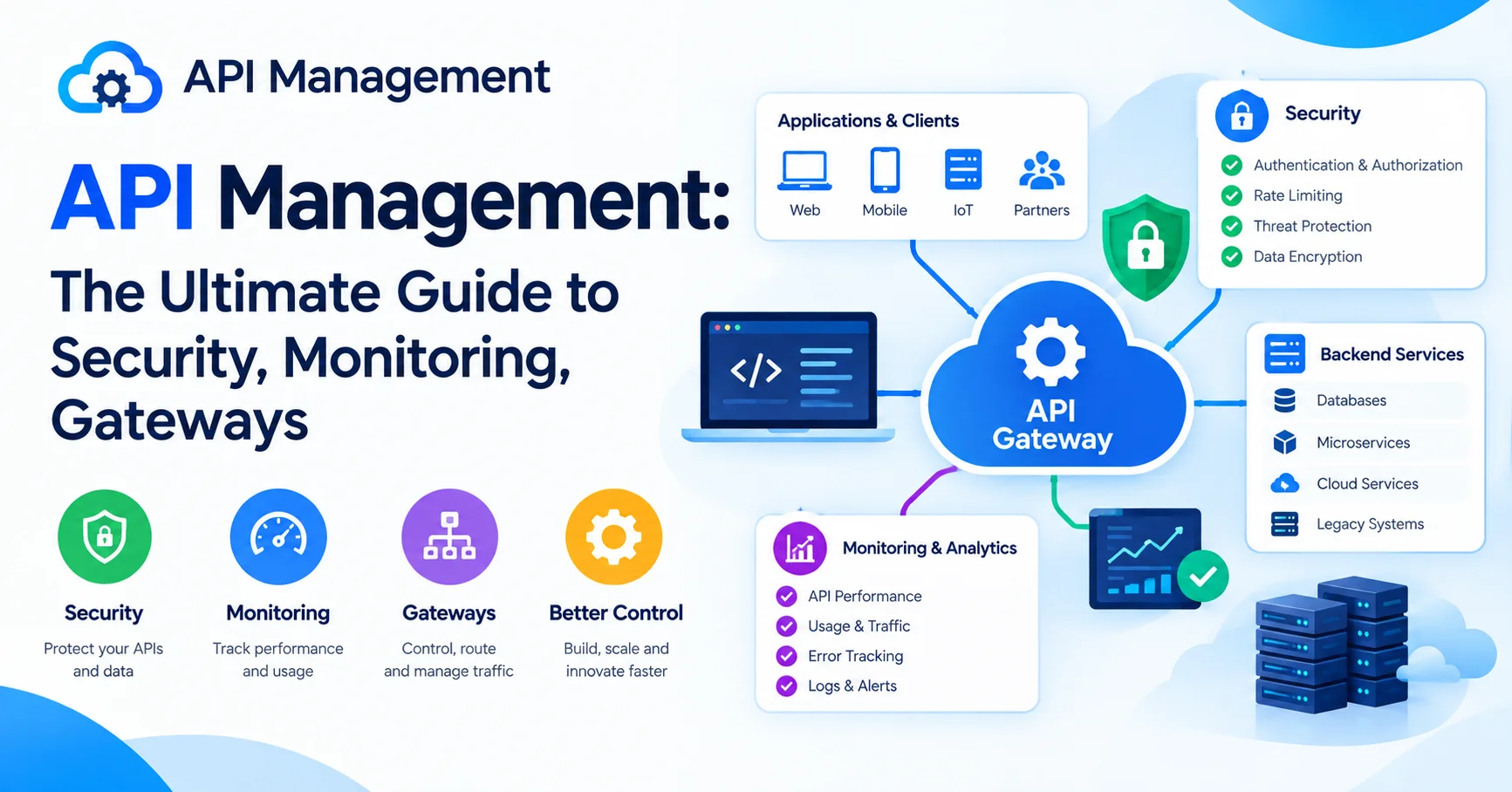
API management is the practice of designing, publishing, securing, monitoring, and analyzing APIs in a structured and scalable way. Think of it as the operating system for your APIs — it keeps everything running smoothly, securely, and efficiently.
According to Postman’s 2024 State of the API Report, 66% of developers spend more time working with APIs than they did three years ago. And Gartner predicts that by 2026, over 90% of enterprise applications will rely on APIs as their primary integration method.
Without a proper API management strategy, companies face:
- Security breaches from unprotected endpoints
- Performance bottlenecks from unmonitored traffic
- Developer frustration due to poor documentation and governance
- Compliance risks from ungoverned data flows
💡 Key Insight: OWASP consistently ranks broken object-level authorization and broken authentication among the top API security risks. These aren’t theoretical threats — they’re responsible for real-world breaches at companies like Twitter, Optus, and T-Mobile.
The 4 Core Pillars of API Management
Effective API management rests on four interconnected pillars. Miss one, and the whole system is vulnerable.
1. API Design & Publishing
This is where everything starts. A well-designed API is consistent, versioned, and documented. Tools like OpenAPI/Swagger have become the standard for defining API contracts before a single line of code is written. Good design reduces bugs, speeds up onboarding, and makes life easier for the developers who consume your APIs.
2. API Security
Security is not a feature — it’s a foundation. We’ll dive deep into this in the next section.
3. API Monitoring & Analytics
You can’t improve what you can’t measure. Real-time monitoring helps you detect anomalies, track usage patterns, and respond to incidents before they escalate.
4. API Gateway
The gateway is the traffic cop of your API infrastructure. It routes requests, enforces policies, and acts as the single point of entry for all API calls.
API Security: The Non-Negotiable Layer
When discussing API management, security deserves its own serious chapter. The OWASP API Security Top 10 (2023 edition) gives us a clear picture of what threats look like in practice.
Common API Security Threats in 2026
| Threat | Description | Risk Level |
|---|---|---|
| Broken Object Level Authorization (BOLA) | Accessing data belonging to other users | 🔴 Critical |
| Broken Authentication | Weak or missing token validation | 🔴 Critical |
| Excessive Data Exposure | Returning more data than needed | 🟠 High |
| Rate Limiting Abuse | Flooding endpoints with requests | 🟠 High |
| Security Misconfiguration | Open CORS, verbose error messages | 🟡 Medium |
| Injection Attacks | SQL, NoSQL, or command injection via API params | 🔴 Critical |
API Security Best Practices You Should Implement Today
Authentication & Authorization
- Use OAuth 2.0 and OpenID Connect — they’re the industry standards for a reason
- Implement short-lived JWT tokens (expiry ≤ 15 minutes for sensitive operations)
- Always validate tokens server-side — never trust client-side claims
Transport Security
- Enforce TLS 1.3 everywhere — no exceptions, no fallback to TLS 1.2 for new systems
- Use certificate pinning for mobile apps consuming sensitive APIs
- Enable HSTS headers on all API endpoints
Rate Limiting & Throttling
- Define rate limits per API key, not per IP (IPs can be shared)
- Return
429 Too Many Requestswith aRetry-Afterheader - Implement graduated throttling: warn at 80% of limit, block at 100%
Input Validation
- Validate every parameter — type, length, format, range
- Reject requests with unexpected or extraneous fields
- Never expose stack traces or internal error messages in production
API Key Management
- Rotate API keys on a defined schedule (every 90 days is a reasonable baseline)
- Immediately revoke compromised keys — your system should support this in under 60 seconds
- Store keys in secrets managers like AWS Secrets Manager or HashiCorp Vault, never in code
⚠️ Warning: Hardcoding API keys in source code is still one of the most common (and most avoidable) security mistakes in 2026. Tools like TruffleHog can scan your repositories for exposed secrets — run it before your attackers do.
API Monitoring: Knowing What’s Happening at All Times
Strong API management requires real-time visibility. You need to know not just if an API is working, but how well it’s working and for whom.
What to Monitor
Performance Metrics
- Latency: Track P50, P95, and P99 percentiles — averages lie
- Throughput: Requests per second, broken down by endpoint
- Error Rate: Aim for <0.1% for production APIs
- Availability/Uptime: SLA targets typically start at 99.9%
Business Metrics
- API usage per consumer/client
- Most-called endpoints vs. least-used ones
- Geographic distribution of traffic
Security Metrics
- Failed authentication attempts
- Unusual traffic spikes from single sources
- Requests with malformed headers or payloads
Monitoring Best Practices
- Set up alerting thresholds before problems occur — reactive monitoring is too slow
- Use distributed tracing (OpenTelemetry is the standard in 2026) to track requests across microservices
- Create API health dashboards accessible to both engineering and business teams
- Log structured data (JSON logs, not plain text) to make querying faster
- Implement synthetic monitoring — periodically test your APIs with automated calls, even when no real traffic exists
💡 Pro Tip from experience: One of the most underrated monitoring practices is tracking the consumer side of your APIs. Knowing that one specific client is generating 40% of your error traffic changes your incident response completely. Most teams only look at the server side.
API Gateway: Your Infrastructure’s Front Door
An API gateway sits between your clients and your backend services. It’s the single point of entry that handles routing, authentication, rate limiting, logging, and more.
What a Good API Gateway Does
- Request routing: Directs traffic to the right backend service
- Protocol translation: Converts REST to gRPC, HTTP/1.1 to HTTP/2, etc.
- Authentication enforcement: Validates tokens before requests reach your services
- Load balancing: Distributes traffic intelligently across instances
- Caching: Reduces backend load for repeated requests
- Transformation: Modifies request/response payloads on the fly
Types of API Gateways
| Type | Best For | Examples |
|---|---|---|
| Cloud-native | Teams already on a specific cloud | AWS API Gateway, Azure APIM |
| Self-hosted open source | Full control, cost sensitivity | Kong, Tyk |
| SaaS/Managed | Speed of deployment, less ops burden | Apigee, MuleSoft |
| Microservices-native | Service mesh environments | Envoy, Istio |
Gateway Configuration Tips
- Always version your APIs through the gateway (
/v1/,/v2/) — never break existing consumers - Use the gateway for canary releases — route 5% of traffic to a new version before full rollout
- Centralize CORS configuration at the gateway level, not in individual services
- Enable request/response logging at the gateway but be careful with PII — mask sensitive fields
Best Practices for API Management in 2026
Here’s a consolidated list of API management best practices that high-performing engineering teams actually follow:
Design Phase
- ✅ Design API-first using OpenAPI 3.1 spec
- ✅ Use semantic versioning (
v1.0.0, not justv1) - ✅ Define error responses consistently across all endpoints
- ✅ Write documentation before writing code
Development Phase
- ✅ Enforce code reviews that include API contract review
- ✅ Use mock servers during frontend/backend parallel development
- ✅ Run automated contract tests (Pact.io is excellent for this)
Production Phase
- ✅ Implement circuit breakers to prevent cascade failures
- ✅ Set up automated rollback for failed deployments
- ✅ Use blue-green or canary deployment strategies
Governance
- ✅ Maintain an internal API catalog (a “single source of truth”)
- ✅ Define and enforce API standards company-wide
- ✅ Conduct quarterly API audits — deprecate what’s unused
The 5 Best API Management Tools in 2026: An Honest Comparison
After working with multiple platforms in real-world environments, here’s a transparent assessment of the top tools.
Comparison Table
| Tool | Best For | Pricing | Ease of Use | Gateway Included | Rating |
|---|---|---|---|---|---|
| Kong Gateway | Microservices, open-source | Free / Enterprise | ⭐⭐⭐⭐ | ✅ Yes | ⭐⭐⭐⭐⭐ |
| Apigee (Google) | Enterprise, analytics | $$$$ | ⭐⭐⭐ | ✅ Yes | ⭐⭐⭐⭐ |
| AWS API Gateway | AWS-native teams | Pay-per-use | ⭐⭐⭐⭐ | ✅ Yes | ⭐⭐⭐⭐ |
| MuleSoft Anypoint | Enterprise integration | $$$$ | ⭐⭐⭐ | ✅ Yes | ⭐⭐⭐⭐ |
| Tyk | Cost-conscious teams, self-hosted | Free / Enterprise | ⭐⭐⭐⭐ | ✅ Yes | ⭐⭐⭐⭐ |
1. Kong Gateway ⭐⭐⭐⭐⭐

Kong Gateway is an API gateway and cloud-native API management platform designed to control, secure, and manage API traffic between clients and backend services. It provides features such as authentication, rate limiting, traffic control, logging, monitoring, and request transformation, helping organizations protect APIs and improve their reliability and performance. Kong Gateway is particularly well suited to microservices and distributed architectures, where it can act as a centralized entry point for managing communication between applications and services. With support for plugins, automation, and modern cloud environments, Kong Gateway provides developers and DevOps teams with a flexible solution for building and operating secure, scalable API infrastructures.
Kong is arguably the most popular open-source API gateway in the world, and for good reason. Built on NGINX and Lua, it’s blazing fast and highly extensible through plugins.
Strengths:
- 300+ available plugins (authentication, rate limiting, logging, etc.)
- Excellent Kubernetes integration via Kong Ingress Controller
- Strong community and enterprise support
Weaknesses:
- Configuration can get complex at scale
- The free version lacks a proper admin UI (need to use CLI or the paid Konnect)
Best for: Teams running microservices on Kubernetes who want performance and flexibility without vendor lock-in.
2. Apigee (Google Cloud) ⭐⭐⭐⭐
Apigee is an API management platform from Google Cloud that helps organizations design, secure, publish, monitor, and analyze APIs across cloud and hybrid environments. It provides tools for API proxies, authentication, access control, traffic management, rate limiting, analytics, and developer engagement. Apigee can help businesses expose backend services securely while maintaining control over API usage and performance. With its integration into the Google Cloud ecosystem and support for scalable API architectures, Apigee is designed for organizations that need centralized API governance, security, monitoring, and lifecycle management.
Apigee is Google’s enterprise API management platform and one of the most mature products in the space. It shines on analytics and developer portal features.
Strengths:
- Best-in-class API analytics dashboard
- Excellent developer portal out of the box
- Strong policy management and traffic control
Weaknesses:
- Very expensive — pricing can reach tens of thousands per month
- Steep learning curve for teams new to the platform
- Tightly coupled to Google Cloud ecosystem
Best for: Large enterprises with complex API ecosystems and a significant budget.
3. AWS API Gateway ⭐⭐⭐⭐
AWS API Gateway is a fully managed service from Amazon Web Services that allows developers to create, publish, secure, monitor, and manage APIs at scale. It can act as an entry point between client applications and backend services, including AWS Lambda, Amazon EC2, and other AWS resources. The service supports features such as authentication, authorization, throttling, caching, monitoring, and traffic management, helping organizations build secure and reliable API-driven applications. With its integration with the broader AWS ecosystem and serverless services, AWS API Gateway provides a scalable solution for managing APIs without requiring teams to maintain their own gateway infrastructure.
AWS API Gateway is the natural choice for teams already invested in the AWS ecosystem. It integrates seamlessly with Lambda, DynamoDB, IAM, and CloudWatch.
Strengths:
- Zero infrastructure to manage
- Native integration with the entire AWS stack
- Pay-per-use pricing — ideal for variable workloads
Weaknesses:
- Limited flexibility outside of AWS
- Cold start latency with Lambda integrations can be frustrating
- Monitoring requires additional CloudWatch setup
Best for: AWS-native applications, serverless architectures, and teams who want to minimize DevOps overhead.
4. MuleSoft Anypoint Platform ⭐⭐⭐⭐
MuleSoft Anypoint Platform is an integration and API management platform designed to help organizations connect applications, data, devices, and services across cloud and on-premises environments. It provides tools for designing, building, securing, deploying, managing, and monitoring APIs and integrations throughout their lifecycle. The platform also supports API governance, reusable integration components, analytics, and centralized management, making it useful for organizations working with complex IT environments. By combining API management with application and data integration capabilities, MuleSoft Anypoint Platform helps businesses create connected systems and streamline the development of modern digital services.
MuleSoft Anypoint (now part of Salesforce) goes beyond API management into full integration platform territory. It’s overkill for pure API needs but unmatched for enterprise integration.
Strengths:
- Excellent for connecting legacy systems with modern APIs
- Built-in iPaaS capabilities
- Strong governance and compliance tools
Weaknesses:
- Extremely high cost (one of the most expensive options)
- Requires specialized MuleSoft expertise
- Heavy platform — slower to deploy than lighter alternatives
Best for: Large enterprises dealing with complex legacy integrations, especially Salesforce shops.
5. Tyk ⭐⭐⭐⭐

Tyk is an open-source API management platform designed to help organizations build, secure, manage, and monitor APIs across cloud, hybrid, and on-premises environments. Its platform includes an API gateway, authentication and authorization, rate limiting, analytics, traffic management, and API lifecycle management features. Tyk is particularly useful for organizations adopting microservices and distributed architectures because it provides centralized control over API traffic while supporting flexible deployment options. With its open-source foundation and extensive configuration capabilities, Tyk offers developers and DevOps teams a flexible solution for managing secure and scalable API ecosystems.
Tyk is often overlooked but deserves serious attention. It’s a fully open-source API management platform written in Go, which means it’s fast and resource-efficient.
Strengths:
- 100% open-source — no feature gating in the free version
- Excellent dashboard and developer portal included
- GraphQL and gRPC support out of the box
- Lower resource consumption than Kong
Weaknesses:
- Smaller community than Kong
- Enterprise support can be slow to respond
- Less third-party integrations compared to Kong
Best for: Cost-conscious teams who want a complete, self-hosted API management solution without paying enterprise prices.
API Management Quick-Reference Checklist
Use this before going to production:
✅ Pre-Production API Management Checklist
Security
- OAuth 2.0 / OpenID Connect implemented
- TLS 1.3 enforced on all endpoints
- Rate limiting configured per API key
- Input validation on all parameters
- No sensitive data in error messages
- API keys stored in secrets manager
Gateway
- API versioning configured (
/v1/) - CORS policies set at gateway level
- Circuit breakers in place
- Load balancing configured
Monitoring
- P95/P99 latency alerts configured
- Error rate alerting set up
- Structured logging enabled
- Distributed tracing active
Documentation
- OpenAPI 3.1 spec published
- Developer portal accessible
- Deprecation policy documented
Frequently Asked Questions About API Management
What is API management in simple terms?
API management is the process of overseeing the entire lifecycle of your APIs — from design and publication to security, monitoring, and retirement. Think of it as a control tower for all the digital connections your software makes with the outside world.
What’s the difference between an API gateway and API management?
An API gateway is one component of API management. The gateway handles traffic routing and enforcement of policies at runtime. API management is the broader discipline that includes design, documentation, security governance, developer portals, analytics, and lifecycle management.
Do small companies need API management?
Yes — even if you only have 5 APIs. Starting with good practices early (versioning, documentation, basic monitoring) is dramatically easier than retrofitting governance into a chaotic API landscape later. Tools like Tyk or Kong’s free tier make it accessible without a big budget.
How do I secure an API in 2026?
Use OAuth 2.0 for authentication, enforce TLS 1.3, implement rate limiting per consumer, validate all inputs, store secrets in a dedicated secrets manager, and follow the OWASP API Security Top 10 as your baseline. Regular security audits and automated scanning are also essential.
What is the best API management tool for startups?
For most startups, Kong Gateway (free, open-source) or Tyk offers the best balance of features, performance, and cost. AWS API Gateway is ideal if you’re already on AWS and want zero-maintenance infrastructure.
How much does API management cost?
It varies widely. Open-source options like Kong and Tyk are free to self-host (you pay for infrastructure). Managed cloud services like AWS API Gateway charge per request (roughly $3.50 per million calls). Enterprise platforms like Apigee or MuleSoft can cost $5,000–$50,000+ per month depending on scale.
What is API versioning and why is it important?
API versioning is the practice of assigning version identifiers (like /v1/, /v2/) to your APIs so that changes don’t break existing consumers. It’s essential for maintaining backward compatibility while still allowing your API to evolve.
Conclusion: Build Your API Management Strategy Before You Need It
Here’s the honest truth: most companies only invest seriously in API management after something goes wrong — a security breach, a production outage, or a developer revolt against undocumented endpoints. By then, the technical debt is enormous.
The teams that get this right from day one share a common approach: they treat APIs as products, not plumbing. That means intentional design, documented contracts, enforced security, real-time monitoring, and a gateway that enforces consistent policies across every request.
The five tools covered in this guide — Kong, Apigee, AWS API Gateway, MuleSoft, and Tyk — each have genuine strengths. There’s no single winner. The right choice depends on your team’s size, budget, infrastructure preferences, and how complex your API ecosystem is.
Start with the checklist. Implement security fundamentals first. Pick a gateway that fits your current scale. Add monitoring that gives you visibility into what actually matters. Then build from there.
The best API management strategy isn’t the most sophisticated one — it’s the one your team will actually maintain and improve over time.