The Ultimate Twilio API Guide: Messaging, Voice, Pricing & Top 5 Alternatives

Introduction To Twilio API
If you are building an application that requires communication—whether it’s sending OTPs, automating customer support via WhatsApp, or routing inbound voice calls—you have undoubtedly encountered the Twilio API. But is it still the undisputed king of CPaaS (Communications Platform as a Service) in 2026, or have hidden costs and complex compliance rules made it time to look elsewhere?
Here is the short answer: The Twilio API remains the most robust, developer-friendly, and feature-rich communication platform on the market. However, its pricing model has become increasingly complex, and strict carrier compliance (like A2P 10DLC) means it is no longer a “plug-and-play” solution for beginners.
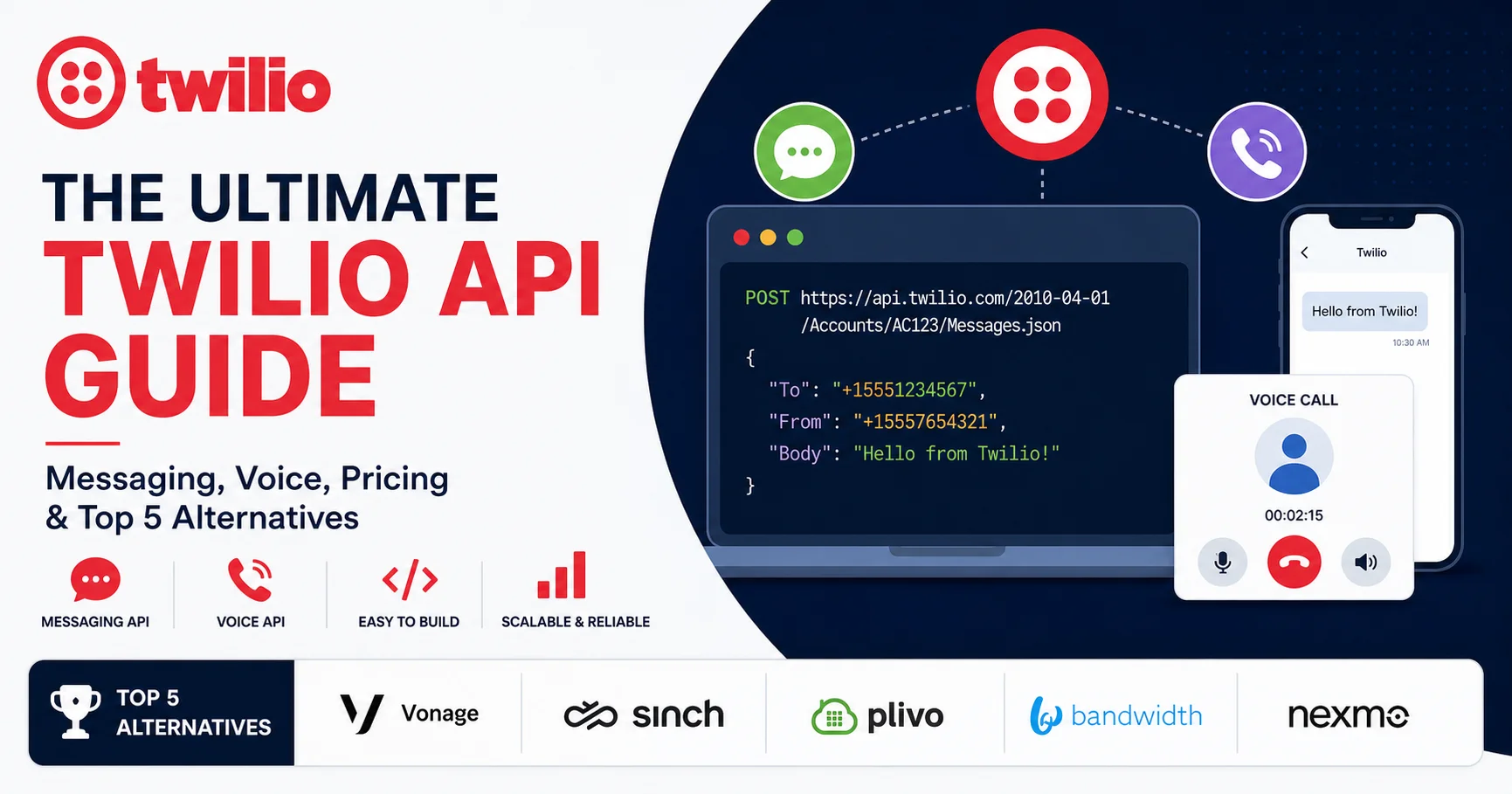
In this definitive guide, I will share my real-world experience deploying the Twilio API at scale. We will cover messaging, voice capabilities, a brutally honest breakdown of the Twilio pricing 2026 structure, practical integration examples, and a comprehensive CPaaS comparison featuring the best 5 Twilio alternatives.
By the end of this article, you will have the exact knowledge needed to architect your communication stack, avoid costly billing traps, and decide if Twilio is the right fit for your business.
What is the Twilio API?
At its core, the Twilio API is a cloud communications platform that allows software developers to programmatically make and receive phone calls, send and receive text messages, and perform other communication functions using its web service APIs.
Instead of building your own telecom infrastructure, dealing with carrier agreements, or managing physical SIP trunks, Twilio abstracts the complexity into clean, RESTful APIs and SDKs.
The Core Pillars of the Twilio Ecosystem
- Programmable Messaging: SMS, MMS, WhatsApp, and RCS.
- Programmable Voice: Inbound/outbound calls, SIP trunking, and IVR (Interactive Voice Response).
- Programmable Video: WebRTC-based video and audio rooms.
- Verify API: Out-of-the-box 2FA and OTP generation.
- CustomerAI & Flex: AI-driven contact center solutions.
“The true power of the Twilio API isn’t just in sending a message; it’s in the programmable logic you can wrap around it. You aren’t just sending an SMS; you are triggering a workflow based on user behavior.”
Twilio Messaging & Voice: Features & Real-World Use Cases
Having integrated the Twilio API into multiple SaaS products, I can tell you that the documentation is phenomenal, but the real-world application requires strategic planning.
1. Programmable Messaging (SMS & WhatsApp)
Sending an SMS via the Twilio API is as simple as a single POST request. However, the landscape of SMS has changed drastically.
- A2P 10DLC Compliance: If you are sending SMS to US numbers, you must register your brand and campaigns. Twilio will block your messages if you fail to do this.
- WhatsApp Business API: Twilio is an official Meta partner. You can use the API to send rich media, interactive buttons, and template messages.
- Carrier Filtering: Carriers actively block spam. Using Twilio’s Lookup API to verify numbers before sending is a best practice I highly recommend to protect your sender reputation.
2. Programmable Voice & SIP Trunking
Twilio uses TwiML (Twilio Markup Language), an XML-based language, to instruct the API on how to handle calls.
- IVR & Call Routing: Build complex call trees without touching a physical PBX.
- SIP Trunking (Elastic SIP Trunking): Connect your existing on-premise PBX or custom VoIP setup to the PSTN via Twilio’s global network.
- Real-time Speech Recognition: Integrate AI transcription directly into live voice calls using Twilio’s Media Streams.
💡 Experience Note: When building IVR systems with the Twilio API, always implement a “fallback” route. If your webhook server goes down or times out, Twilio needs to know whether to play a voicemail prompt or disconnect. I learned this the hard way during a Black Friday traffic spike!
Twilio Pricing in 2026: Is It Still Worth It?
Let’s be brutally honest: Twilio pricing in 2026 is not for the faint of heart, especially if you are operating on thin margins. Twilio operates on a pay-as-you-go model, which is great for startups, but it can become expensive at enterprise scale.
The Cost Breakdown (Estimates for 2026)
| Feature | Base Cost (US) | Hidden Costs to Watch |
|---|---|---|
| SMS (Local) | ~$0.0079 / msg | Carrier fees, A2P registration fees. |
| SMS (Toll-Free) | ~$0.0115 / msg | Monthly number lease (~$1.15/mo). |
| Voice (Inbound) | ~$0.0085 / min | TwiML webhook execution, recording costs. |
| Voice (Outbound) | ~$0.0140 / min | Varies heavily by destination country. |
| Phone Numbers | ~$1.15 / month | Porting fees, advanced features cost extra. |
| Lookup API | ~$0.008 / req | Line type intelligence costs more. |
The “Gotchas” of Twilio Billing
- Support Tiers: Basic support is free, but if you need a dedicated Technical Account Manager (TAM) or SLA guarantees, you will pay a premium percentage of your monthly bill.
- Webhook Costs: Every time Twilio hits your webhook for a status update, you are paying for the compute to process it.
- Data Retention: Storing call recordings and SMS logs on Twilio’s servers incurs monthly storage fees. Pro-tip: Download and move them to AWS S3 immediately via a script.
Twilio Integration Guide: Code Examples & Best Practices
To truly understand the Twilio API, you need to see it in action. Below is a practical Twilio integration guide using Node.js and Python, including crucial security practices.
Prerequisites
You will need a Twilio Account SID, Auth Token, and a verified phone number. Install the helper library:npm install twilio or pip install twilio
Example 1: Sending an SMS with Node.js
// Import the Twilio Node.js helper library
const client = require('twilio')(
  process.env.TWILIO_ACCOUNT_SID,
  process.env.TWILIO_AUTH_TOKEN
);

async function sendWhatsAppMessage() {
  try {
    const message = await client.messages.create({
      body: 'Your 2026 order is confirmed! Track it here: bit.ly/track',
      from: 'whatsapp:+14155238886', // Twilio Sandbox/WhatsApp Number
      to: 'whatsapp:+1234567890'     // User's WhatsApp Number
    });
    console.log(`Message sent successfully. SID: ${message.sid}`);
  } catch (error) {
    console.error('Twilio API Error:', error.message);
  }
}
sendWhatsAppMessage();
Example 2: Handling Inbound Voice via Webhooks (Python/Flask)
When someone calls your Twilio number, Twilio makes an HTTP request to your server. You must respond with TwiML.
from flask import Flask, request
from twilio.twiml.voice_response import VoiceResponse, Gather, Say

app = Flask(__name__)

@app.route("/voice", methods=['GET', 'POST'])
def voice():
    """Handle incoming voice calls via Twilio API webhooks."""
    response = VoiceResponse()

    # Gather user input (DTMF or Speech)
    gather = Gather(num_digits=1, action='/menu', method='POST')
    gather.say('For sales, press 1. For support, press 2.')
    response.append(gather)

    # Fallback if no input is received
    response.redirect('/voice')
    return str(response)

if __name__ == "__main__":
    app.run(port=5000)
⚠️ Critical Security Warning: Never trust a webhook blindly. Anyone can spoof a POST request to your `/voice` endpoint. You MUST validate the request signature using your Auth Token. The Twilio helper libraries have built-in methods for this. Failing to secure your webhooks can lead to toll fraud, where hackers route expensive international calls through your account.
The Pros and Cons of Twilio (Honest Review)
Before we look at the Twilio alternatives, let’s summarize the platform’s standing in 2026.
✅ The Pros
- Unmatched Documentation & SDKs: The developer experience (DX) is industry-leading.
- Global Reach: Direct carrier connections in over 150 countries.
- Ecosystem: Seamless integration with Segment, SendGrid, and Front.
- Reliability: Enterprise-grade uptime and redundancy.
❌ The Cons
- Cost at Scale: Margins shrink significantly compared to direct carrier aggregators.
- Compliance Headaches: Navigating A2P 10DLC and global sender ID regulations requires dedicated administrative time.
- Complex Dashboard: The console can be overwhelming for non-technical stakeholders trying to view analytics.
Top 5 Twilio Alternatives in 2026 (With Ratings)
If the Twilio pricing 2026 structure doesn’t fit your budget, or if you need a more specialized CPaaS, here is a CPaaS comparison of the top 5 Twilio alternatives.
Quick Comparison Table
| Platform | Best For | Pricing vs Twilio | Ease of Use | Developer Rating |
|---|---|---|---|---|
| Twilio | Enterprise, Omnichannel, AI | Baseline | ⭐⭐⭐⭐ | ⭐⭐⭐⭐⭐ |
| Vonage | UCaaS, Video, Global SMS | Slightly Cheaper | ⭐⭐⭐ | ⭐⭐⭐⭐ |
| Plivo | High Volume SMS, Cost-Saving | 20-30% Cheaper | ⭐⭐⭐⭐ | ⭐⭐⭐⭐ |
| Bird | WhatsApp, Marketing, Retail | Competitive | ⭐⭐⭐⭐⭐ | ⭐⭐⭐ |
| Sinch | Enterprise Voice, Global Reach | Negotiable | ⭐⭐⭐ | ⭐⭐⭐⭐ |
| Bandwidth | Direct Carrier, Massive Scale | 40%+ Cheaper | ⭐⭐ | ⭐⭐⭐ |
1. Vonage (formerly Nexmo)
Vonage (formerly Nexmo) is a cloud communications platform that enables developers to integrate messaging, voice calls, video, and verification features into applications through APIs. Its communications APIs support SMS messaging, WhatsApp interactions, voice services, and two-factor authentication, helping businesses improve customer engagement and secure user accounts. Vonage also provides tools for building automated notifications, customer support workflows, and real-time communication experiences. Developers can integrate its services into websites, mobile applications, and business systems using available SDKs and documentation. With scalable cloud infrastructure and global communication capabilities, Vonage is a useful option for companies seeking to automate messaging, enhance authentication, and build reliable communication solutions without managing their own telecom infrastructure.
Vonage is Twilio’s oldest rival. While Twilio dominates the pure developer API space, Vonage excels in unified communications and video APIs.
- Why choose it? If you need a mix of CPaaS APIs and ready-made UCaaS (Unified Communications) tools for your internal team.
- The Verdict: Great documentation, but the API feels slightly more rigid than the Twilio API.
2. Plivo
Plivo is a cloud communications platform that enables businesses and developers to integrate voice calling, SMS messaging, and other communication capabilities into their applications through APIs. It provides tools for sending notifications, automating customer interactions, building contact center solutions, and implementing phone-based verification. Plivo supports programmable voice and messaging workflows, allowing companies to manage communications across different markets without maintaining their own telecom infrastructure. Its developer-friendly APIs, SDKs, and integration options make it suitable for SaaS platforms, e-commerce businesses, customer support teams, and enterprises seeking scalable communication solutions. By automating messaging and voice processes, Plivo helps organizations improve customer engagement, streamline workflows, and build reliable communication experiences.

Plivo is the go-to Twilio alternative for startups and mid-sized companies that want to cut messaging costs without sacrificing API quality.
- Why choose it? Plivo owns its own carrier network in several countries, allowing them to bypass aggregators and pass the savings to you. Their PHLO (visual workflow builder) is fantastic for non-developers.
- The Verdict: Excellent for high-volume SMS. The Twilio API is more feature-rich for AI/Voice, but Plivo wins on ROI.
3. Bird (formerly MessageBird)

Bird (formerly MessageBird) is a cloud communications and customer engagement platform that helps businesses connect with customers through messaging, email, voice, and other digital channels. It provides APIs and automation tools for building communication workflows, sending transactional notifications, managing customer conversations, and delivering personalized marketing campaigns. Bird supports channels such as SMS, WhatsApp, and email, enabling businesses to coordinate customer interactions across multiple touchpoints. Its platform is useful for e-commerce companies, SaaS providers, and enterprises looking to automate communication and improve customer engagement. By combining communication APIs with workflow automation and customer data capabilities, Bird helps organizations streamline messaging operations and create more consistent customer experiences.
If your business relies heavily on WhatsApp, conversational commerce, or retail marketing, Bird is a powerhouse.
- Why choose it? Bird’s Flow Builder and omnichannel routing are tailored for marketing teams, not just backend developers.
- The Verdict: Less focused on raw backend voice infrastructure, but unbeatable for customer engagement and WhatsApp Business API integration.
4. Sinch
Sinch is a cloud communications platform that helps businesses connect with customers through SMS, voice, email, and messaging channels such as WhatsApp. It offers communication APIs that developers can integrate into websites, mobile applications, and business systems to automate notifications, enable two-factor authentication, and support customer engagement. Sinch also provides solutions for contact centers, marketing campaigns, and conversational messaging, helping organizations manage communications across multiple channels. Its scalable infrastructure and developer tools make it suitable for businesses of different sizes seeking to improve communication reliability and reach customers worldwide. Sinch is a useful option for companies looking to build automated messaging workflows and integrate communication capabilities directly into their applications.

Sinch is a massive global player that actually powers the backend of many other CPaaS providers.
- Why choose it? If you are an enterprise with massive global voice and SMS needs and want to negotiate direct contracts.
- The Verdict: Sinch is less “developer-friendly” out of the box compared to the Twilio API. It requires more legwork to set up but offers superior margins at the enterprise level.
5. Bandwidth
Bandwidth is a cloud communications platform that provides APIs for integrating voice calling, SMS messaging, and emergency calling capabilities into business applications. It combines programmable communications technology with its own telecommunications network, helping organizations manage communications with greater control and reliability. Developers can use Bandwidth APIs to automate notifications, enable two-factor authentication, build contact center solutions, and support customer communication workflows. The platform is particularly useful for enterprises, SaaS providers, and communication service providers that require scalable voice and messaging infrastructure. With tools for managing phone numbers, messaging, and voice services, Bandwidth helps businesses integrate telecommunications directly into their applications while simplifying communication operations.
Bandwidth is not a CPaaS in the traditional sense; they are a Tier-1 carrier. They actually provide the underlying network for companies like Google and Microsoft.
- Why choose it? If you have an in-house telecom engineering team and want to cut out the middleman entirely.
- The Verdict: Do not use Bandwidth if you want quick, plug-and-play SDKs. Use them if you are building a telecom product and need raw SIP trunking and SMS at rock-bottom prices.
Practical Checklist: Should You Choose Twilio?
Use this checklist to make your final architectural decision.
- Do you need rapid time-to-market? (Yes = Twilio)
- Is your team composed of modern web developers? (Yes = Twilio)
- Are you sending > 1 Million SMS/month with tight margins? (Yes = Look at Plivo/Bandwidth)
- Do you need complex AI Voice agents and WebRTC? (Yes = Twilio)
- Is your primary focus WhatsApp Marketing in LATAM/EMEA? (Yes = Bird)
- Do you have the budget to handle compliance and support tiers? (Yes = Twilio)
Frequently Asked Questions (FAQs)
1. Is the Twilio API free to use?
No. Twilio operates on a pay-as-you-go model. You pay for phone number leases, per-message fees, per-minute voice costs, and API lookup requests. However, they offer a free trial credit for testing.
2. How does Twilio handle A2P 10DLC compliance?
Twilio provides a dashboard and API endpoints to register your Brand and Campaigns. However, the approval process is handled by The Campaign Registry (TCR). Twilio will block unregistered messages to US numbers to protect their routing reputation.
3. Can I use the Twilio API for AI voice bots?
Absolutely. With Twilio Media Streams and integrations with tools like Deepgram or OpenAI, you can build real-time, low-latency AI voice agents that transcribe and respond during live phone calls.
4. What is the best Twilio alternative for cheap SMS?
Plivo and Bandwidth are generally the best alternatives for high-volume, low-cost SMS. Plivo offers a developer-friendly API similar to Twilio, while Bandwidth is better for massive enterprise scale.
5. How do I secure my Twilio webhooks?
You must validate the X-Twilio-Signature header on every incoming HTTP request. The Twilio Helper Libraries (Node, Python, PHP, etc.) include a RequestValidator class to ensure the request actually originated from Twilio.
Conclusion
The Twilio API remains the gold standard for programmable communications in 2026. Its unparalleled documentation, global reach, and continuous innovation in AI and WebRTC make it the default choice for developers building the next generation of connected apps.
However, the landscape has matured. The days of sending millions of SMS messages via Twilio without worrying about carrier compliance or optimizing margins are over. If you are building an enterprise-grade, omnichannel experience and have the budget for it, Twilio is an investment that will pay off in reliability and speed.
But, if your primary goal is cost-reduction on high-volume SMS, or if you are strictly focused on WhatsApp marketing, exploring Twilio alternatives like Plivo or Bird is a smart, strategic move.
Ultimately, the “best” platform depends entirely on your specific use case, your team’s technical expertise, and your margin requirements. Use the integration examples and checklist provided in this guide to architect a communication stack that scales seamlessly with your business.
Ready to start building? Head over to the official Twilio Documentation to create your free trial account and write your first line of code today.